DeepInfra raises $107M Series B to scale the inference cloud — read the announcement
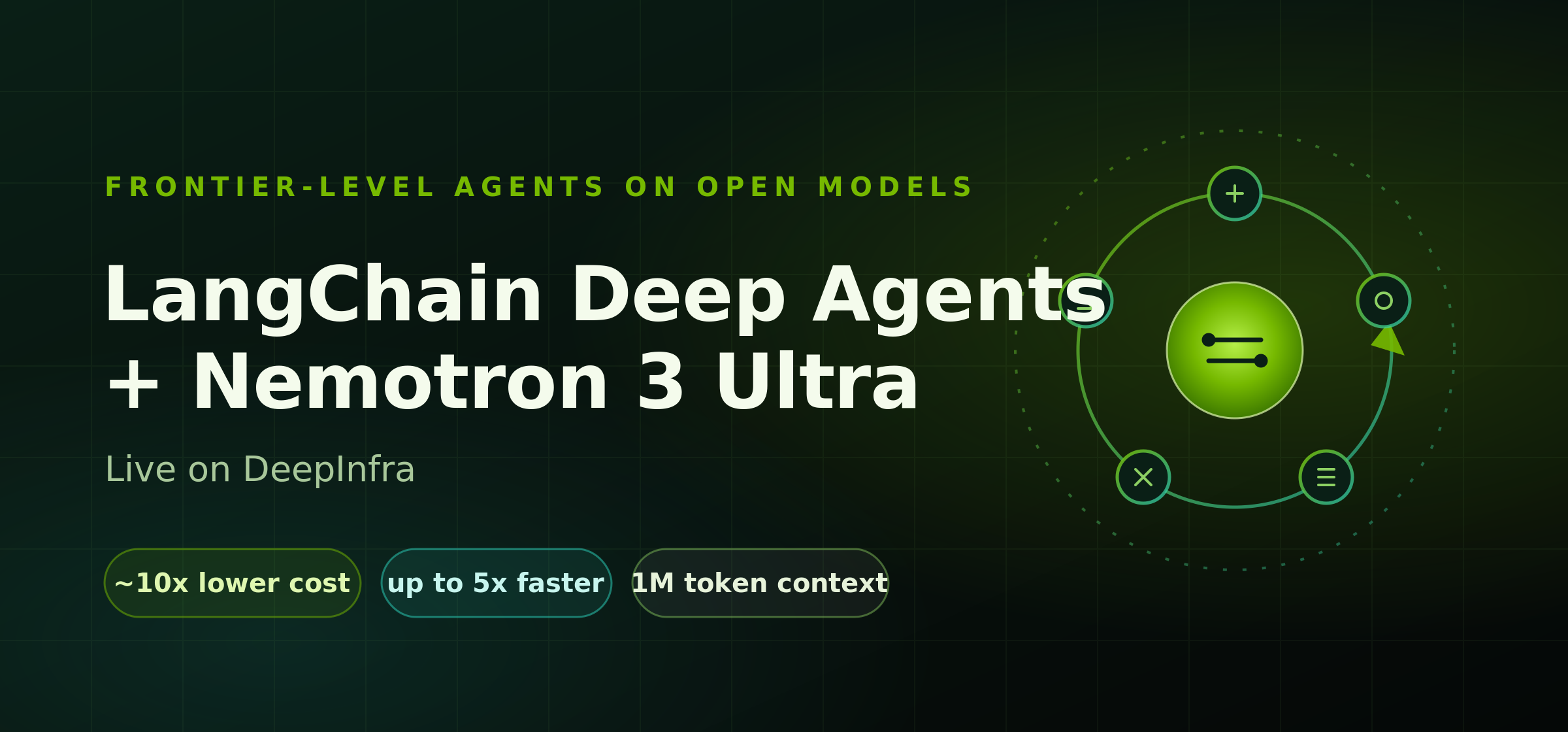
Open models have reached frontier-level agent performance. Starting today, you can point LangChain Deep Agents at NVIDIA Nemotron 3 Ultra running on DeepInfra and get top-tier agent accuracy at roughly 10x lower cost than leading closed models.
Agent quality is no longer just about the model. It's about the harness — the prompts, tools, and middleware wrapped around the model loop. LangChain proved this by tuning their Deep Agents harness specifically for Nemotron 3 Ultra, with no model retraining. The result: top agent accuracy among open models on LangChain's Deep Agents evaluation suite, at approximately 10x lower cost per run than closed alternatives.
And you can run all of it on DeepInfra today.
Why the harness matters
An agent is a model plus a harness. The model generates; the harness is everything around the loop — the system prompt, the tool descriptions, the sandbox configuration, and the middleware that shapes behavior. LangChain's tuning process started by running Nemotron 3 Ultra against their public Deep Agents benchmark suite, then analyzing execution traces to find where the model underperformed.
From that analysis, LangChain published a Deep Agents model profile tuned specifically for Nemotron 3 Ultra, covering system prompts, tool descriptions, and sandbox configuration. No retraining. The gains came entirely from engineering the environment around the model.
"Top agent accuracy among open models at approximately 10x lower cost than closed alternatives."
For developers, this means the hard part is already done. The tuned harness ships with LangChain Deep Agents. You bring your agent code, point it at a hosted Nemotron 3 Ultra endpoint, and you're running frontier-level agents on open models.
Where DeepInfra fits
LangChain does the harness. NVIDIA provides the open model. DeepInfra is where you run it in production.
Nemotron 3 Ultra is live on DeepInfra now, served through our OpenAI-compatible API. It delivers up to 5x faster inference and up to 30% lower cost for agentic workloads, with support for up to 1M token context. That means LangChain Deep Agents can point at your DeepInfra endpoint with a single configuration change. No new SDK, no custom integration.
Pricing is $0.50 per 1M input tokens and $2.20 per 1M output tokens, with cached input at $0.10. For latency-critical agent traffic, Nemotron 3 Ultra also supports DeepInfra's Priority Tier. And because the whole stack is open — open model, open harness, open runtime — you own it end to end. Customize it, improve it, and run it wherever you need to.
Get started in minutes
Here's the entire integration — LangChain Deep Agents pointed at Nemotron 3 Ultra on DeepInfra:
from deepagents import create_deep_agent
from langchain_openai import ChatOpenAI
def get_weather(city: str) -> str:
"""Get weather for a given city."""
return f"It's always sunny in {city}!"
model = ChatOpenAI(
model="nvidia/NVIDIA-Nemotron-3-Ultra-550B-A55B",
base_url="https://api.deepinfra.com/v1/openai",
api_key="$DEEPINFRA_TOKEN",
)
agent = create_deep_agent(
model=model,
tools=[get_weather],
system_prompt="You are a helpful assistant",
)
result = agent.invoke(
{"messages": [{"role": "user",
"content": "what is the weather in sf"}]}
)
for msg in result["messages"]:
msg.pretty_print()
That's it. The tuned harness comes from LangChain Deep Agents, the model runs on DeepInfra, and you have a frontier-level agent running on open models.
Try it today
Nemotron 3 Ultra is available on DeepInfra now. Check out our developer cookbook for a complete, working example — from setup to a running Deep Agent — and start building.
- Model: deepinfra.com/nvidia/NVIDIA-Nemotron-3-Ultra-550B-A55B
- LangChain integration docs: https://docs.deepinfra.com/integrations/langchain
- LangChain Deep Agents docs: docs.langchain.com/oss/python/deepagents/overview
 Data Sovereignty AI: Why Open-Weight Models Matter<p>The prototype worked. The demo landed. Then the security questionnaire shows up, and question 41 asks which legal entity can be compelled to produce the contents of your prompts. That one question stalls more AI rollouts than latency or accuracy ever have. Inside hospitals, banks, law firms, and defense subcontractors, data sovereignty AI requirements have […]</p>
 Gemma 4 Model Overview: Features, Architecture & Use Cases<p>Gemma 4 is Google DeepMind’s latest family of open-weight models, released on April 3, 2026 under the Apache 2.0 license. The family spans four model sizes — from edge-optimized variants for mobile devices to a 31B dense model for server-side deployments — with every model supporting multimodal input, built-in reasoning, and a context window of […]</p>
 GLM-5.3-Flash API Is Now on DeepInfra<p>Z.ai’s GLM-5.3-Flash activates just 18 billion of its 320 billion parameters at inference time, and on Z.ai’s reported results it outscores Claude Opus 4.8 on DeepSWE v1.1 (63.4 vs. 58.0), a demanding software engineering benchmark. It’s the first natively multimodal model in the GLM-5 series, combining text, image, and video input with a one-million-token context […]</p>




© 2026 DeepInfra. All rights reserved.