DeepInfra raises $107M Series B to scale the inference cloud — read the announcement
NVIDIA Nemotron 3.5 Transcribe is now available on DeepInfra, from day zero of its release. It's an open-weight speech model that handles transcription, speaker attribution, speech translation, contextual biasing, and audio understanding in one model. On DeepInfra it's served through the OpenAI-compatible speech-to-text API, with transcription, word and segment timestamps, contextual prompts, and translation into English available today. Speaker attribution in the API is coming soon.
Teams building call analytics, meeting tools, and media products need more than a raw transcript. They need to know who said what, get domain terms right, handle multilingual recordings, and pull answers out of the audio. One way to build this is to chain an ASR model, a diarization model, a translation model, and an LLM. That works, but it adds integration work and makes the pipeline harder to evaluate.
Nemotron 3.5 Transcribe brings those tasks into one model, so a single request can return a transcript shaped for your application.
What makes Nemotron 3.5 Transcribe different?
Many speech tasks, one model. NVIDIA reports 11 speech tasks in a single checkpoint, including multilingual ASR, speech translation, code-switching, speaker attribution, word timestamps, rich transcription with punctuation and casing, and audio understanding. You orchestrate one model instead of several.
Context-aware transcription. Pass domain terms and product names in a short prompt. The model uses that context to help recognize names that general-purpose ASR often misses, such as drug names, product names, or customer names.
Multilingual. NVIDIA reports transcription in 40 languages, speech translation between English and 31 languages, and code-switching across 13 languages. On DeepInfra, translation into English is available through the OpenAI-compatible /audio/translations endpoint.
Long recordings in one request. Send up to 60 minutes of audio in a single request, with no chunking or stitching on your side.
An efficient Mixture-of-Experts (MoE) design. Nemotron 3.5 Transcribe is a Speech-Augmented Language Model (SALM): speech and speaker encoders feed the autoregressive Nemotron 3.5 Lightning MoE backbone. The 30B-A4B design activates about 4B parameters per token.
Built for recorded audio. It's an offline (non-streaming) model, the choice when you're processing recorded calls, meetings, and media, or running a second pass on live-call transcripts.
How it performs
NVIDIA reports that Nemotron 3.5 Transcribe delivers transcription accuracy on par with leading proprietary speech APIs, with full results in its technical report.
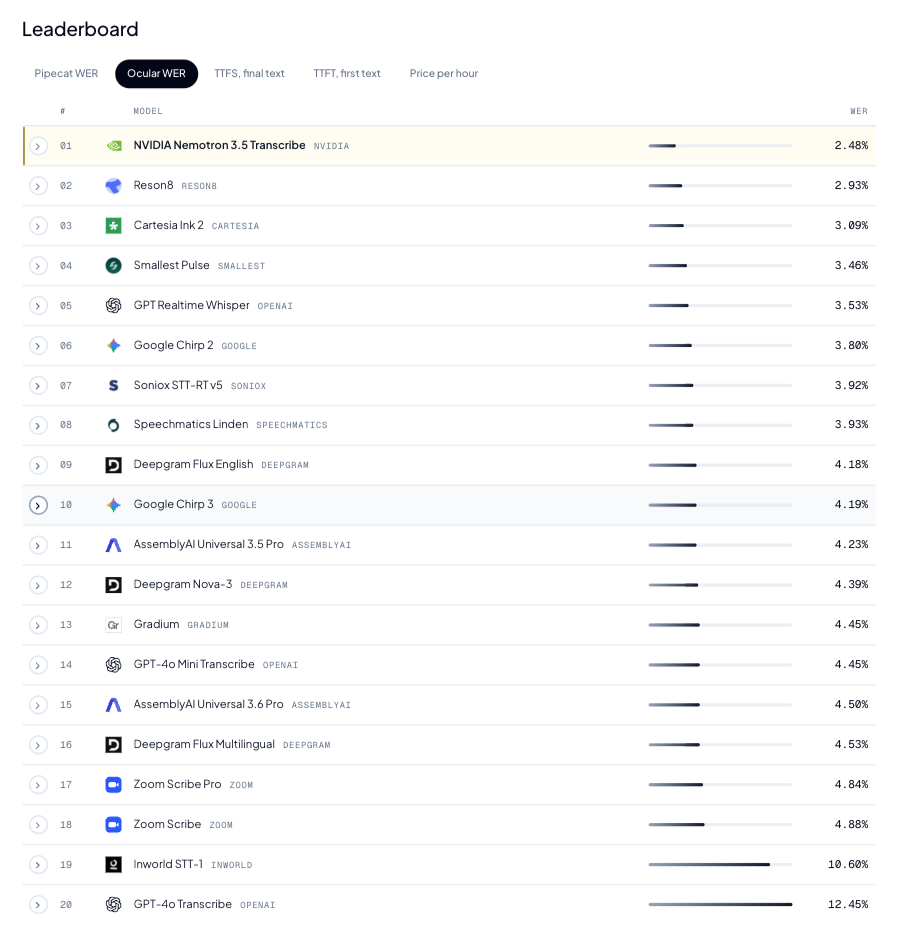
Independent results point the same way. On Cekura's speech-to-text leaderboard, Nemotron 3.5 Transcribe ranks #1 on Ocular WER, an exclusive private dataset Cekura procured, with a 2.48% word error rate, ahead of every proprietary API on the board. A private set is the closest proxy for your own recordings, since no model could have been tuned on it.
On Cekura's public Pipecat WER set, it scores 2.32%, within about half a point of the leader and ahead of Cartesia Ink 2, Speechmatics Linden, Soniox STT-RT v5, and Deepgram Nova-3.
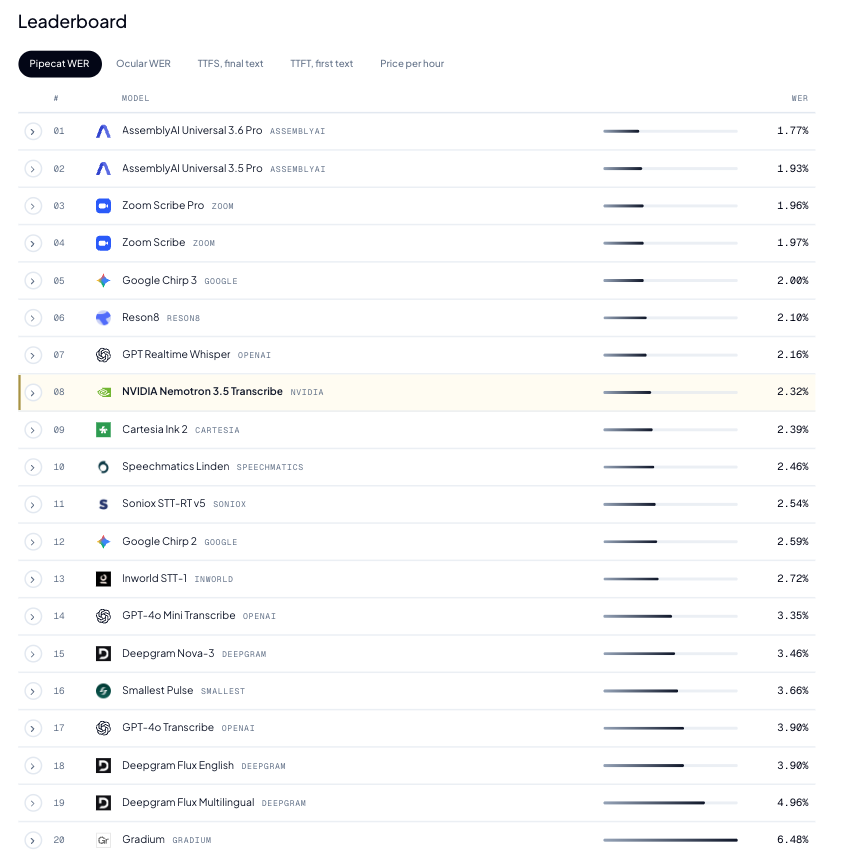
It's the only open-weight model on either leaderboard, so this accuracy comes with weights you can inspect, fine-tune, or run yourself.
What you can build
- Contact center analytics: turn recorded support calls into timestamped transcripts for QA and post-call analysis, with product names supplied as context.
- Meeting and notetaking tools: transcribe meetings up to 60 minutes long, ready for summaries and action items.
- Media and captioning: transcribe recorded media or translate it into English, with word timestamps for captions, search, and navigation.
- Searchable audio archives: pair transcripts with NVIDIA Nemotron 3.5 Embed and Nemotron 3.5 Rerank on DeepInfra to retrieve the right moment from thousands of calls.
Getting started
Nemotron 3.5 Transcribe runs on DeepInfra's OpenAI-compatible speech-to-text endpoint. Point the OpenAI SDK at DeepInfra, send an audio file, and add a short prompt with the terms that matter for your domain.
import os
from openai import OpenAI
client = OpenAI(
api_key=os.environ["DEEPINFRA_API_KEY"],
base_url="https://api.deepinfra.com/v1/openai",
)
with open("support_call.mp3", "rb") as audio:
transcript = client.audio.transcriptions.create(
model="nvidia/NVIDIA-Nemotron-3.5-Transcribe-30B-A4B",
file=audio,
prompt="Customer support call about a GPU cloud bill. "
"Terms: DeepInfra, Nemotron.",
)
print(transcript.text)
For captions or search, ask for word and segment timestamps:
with open("support_call.mp3", "rb") as audio:
transcript = client.audio.transcriptions.create(
model="nvidia/NVIDIA-Nemotron-3.5-Transcribe-30B-A4B",
file=audio,
response_format="verbose_json",
timestamp_granularities=["word", "segment"],
)
for segment in transcript.segments:
print(f"[{segment.start:.1f}s - {segment.end:.1f}s] {segment.text}")
srt and vtt response formats are supported too. To translate speech into English, call client.audio.translations.create with the same model.
Pricing
Nemotron 3.5 Transcribe costs $0.002 per minute of audio ($0.12 per hour). See the model page and pricing page for current rates.
Enterprise security
DeepInfra runs this model with zero data retention: your audio and transcripts aren't stored after the request completes. For details on our security and compliance practices, see the DeepInfra Trust Center.
Try Nemotron 3.5 Transcribe on DeepInfra
Explore the model, check current pricing, and make your first API request.
 Granite 4.2 8B: Model Overview & Integration Guide<p>Granite 4.2 8B is an 8-billion-parameter dense transformer reasoning model developed by IBM. As the mid-size member of the Granite 4.2 family, it balances reasoning depth with operational efficiency. Released under the Apache 2.0 license, the model is built for complex reasoning, code generation, tool calling, and structured data output. Its defining feature is native […]</p>
 9 Best Open-Source Models for Coding (November 2026)<p>Modern artificial intelligence (AI) coding tools now analyze repositories, fix bugs, edit several files, run tests, and execute autonomous development loops. These agentic workflows generate millions of input and output tokens through continuous model calls, and that makes proprietary APIs costly at scale. Open-source coding models offer a cost-effective alternative. You can run them on […]</p>
 Kimi K3.1 Pro on DeepInfra: Pricing, Benchmarks & API<p>Moonshot AI’s Kimi K3.1 Pro posts the top scores in its own comparison table on BrowseComp (92.1) and Humanity’s Last Exam with tools (70.0), ahead of the closed frontier models Moonshot tested against, according to the Kimi K3.1 Pro model card (vendor-reported). Independent testing backs up the headline: Artificial Analysis gives it 46 on its […]</p>


© 2026 DeepInfra. All rights reserved.