DeepInfra raises $107M Series B to scale the inference cloud — read the announcement

zai-org/
GLM-5.3-Flash
$0.15
in
$0.50
out
$0.03
cached
/ 1M tokens
GLM-5.3-Flash is a native multimodal model from Z.ai. It is suited for efficient coding and long-horizon agent tasks. Its hybrid sparse and linear attention architecture maintains accurate long-context behavior while reducing compute overhead.

GLM 5.3 Flash
Ask me anything
Settings
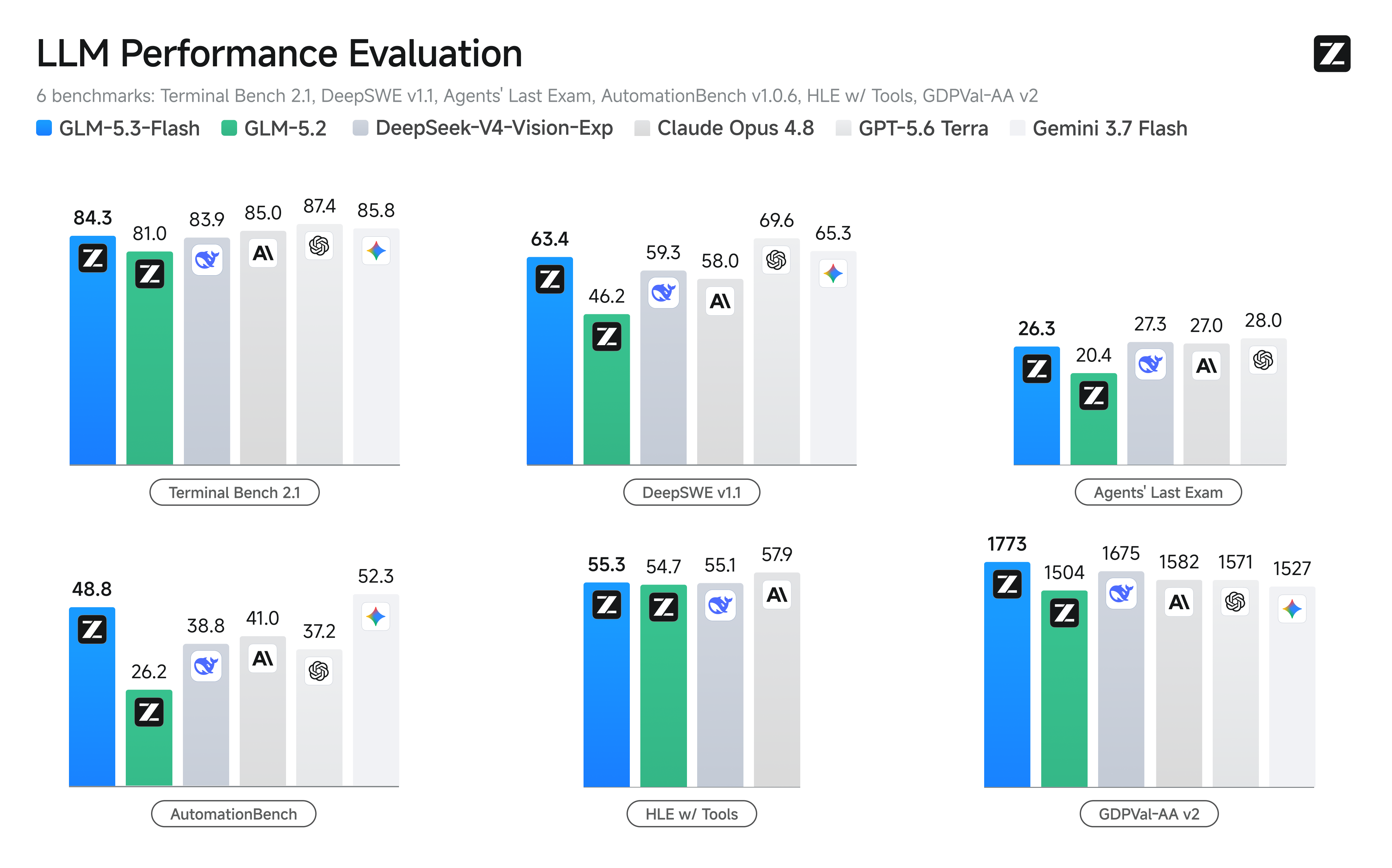
We introduce GLM-5.3-Flash, the first natively multimodal model in the GLM-5 series. With 320B total parameters and just 18B active parameters, it outperforms GLM-5.2 across benchmarks and real-world workloads at one-tenth the price, while approaching Claude Opus 4.8 on coding and agentic benchmarks.
GLM-5.3-Flash starts from a newly trained base model, with its architecture and training recipe redesigned around capability and efficiency. For the first time in the GLM series, we introduce a hybrid architecture combining sparse and linear attention, sharply reducing long-context serving costs while preserving precise long-context capabilities. The model also adopts Manifold-Constrained Hyper-Connections (mHC) to further improve scaling efficiency. Together with our latest 30T-token multimodal pre-training corpus, these changes enable GLM-5.3-Flash to deliver more intelligence with less compute.
Footnotes
- HLE w/ tools (full set): We use sampling parameters of
temperature=1.0andtop_p=0.95for evaluation, with a maximum generation length of163,840tokens. The evaluation is conducted with a maximum context length of300,000tokens, using a context management strategy. We use GPT-5.6-luna (medium) as the judge model. - NL2Repo: We evaluated NL2Repo with temperature=1.0, top_p=1.0, and max_new_tokens=64k under 1M context. To prevent hacking, we use rule-based and a LLM-based judgement to prevent malicious behaviors (e.g., unauthorized pip or curl operations).
- DeepSWE: We run DeepSWE using the mini-swe-agent harness with
temperature=0.95,top_p=1.0,timeout=6hand 400K context. - Terminal-Bench 2.1: We evaluate in Claude Code 2.1.207 with temperature=1.0, top_p=1, max_new_tokens=65536 with 6h timeout.
- Agent’s Last Exam:
- Toolathlon Verified: We obtain all results via the official evaluation service and report pass@1 averaged over 3 independent runs.
- AutomationBench: We evaluate on AutomationBench v1.0.6, incorporating the fix for the
null-type handling issue introduced in PR #13. - GDPval-AA v2: Models are evaluated by Artificial Analysis.
- BabyVision: We use temperature=1.0, top_p=0.95, and a maximum context length of 164K tokens. We resize the input images such that their shorter side is at least 1.5K pixels, consistent with other baselines.




© 2026 DeepInfra. All rights reserved.