DeepInfra raises $107M Series B to scale the inference cloud — read the announcement
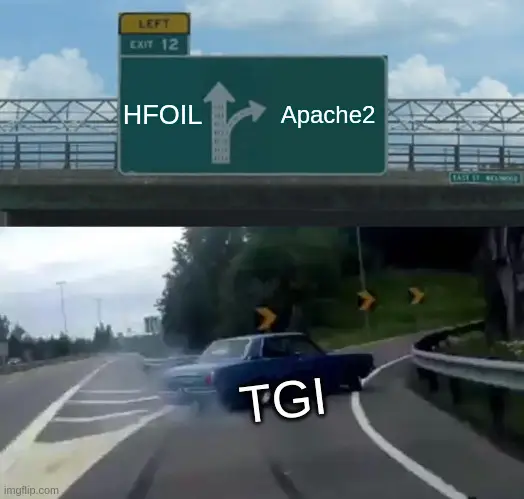
The text generation inference open source project by huggingface looked like a promising framework for serving large language models (LLM). However, huggingface announced that they will change the license of code with version v1.0.0. While the previous license Apache 2.0 was permissive, the new one is restrictive for our use cases.
Forking the project
We decided to fork the project and continue to maintain it under the Apache 2.0 license. We will continue to contribute to the project and keep it up to date. We will accept pull requests from the community, and we will keep the project truly open source and free to use.
Here is a link to the code: https://github.com/deepinfra/text-generation-inference
We hope that in time a community of other developers and organizations that want to keep this project truly open source will form around it.
License changes mid-flight
Sadly it is becoming more and more common for popular open source projects to change their license after they gain some traction. This happened with MongoDB, Grafana, ElasticSearch, and many others. As a developer, when you decide to adopt a particular open source project, you start investing time and effort into using it. You build your application around it, and you start depending on it. Then, suddenly, the license changes, and you might be forced to find an alternative.
Imagine if meta changes the license of pytorch. Or if tomorrow huggingface decides to change the license of transformers in a similar way to prohibit commercial use.
We believe that the changing of the license of open source projects mid-flight is a unfriendly move towards the community.
If you need any help, just reach out to us on our Discord server.
 Gemma 4 Model Overview: Features, Architecture & Use Cases<p>Gemma 4 is Google DeepMind’s latest family of open-weight models, released on April 3, 2026 under the Apache 2.0 license. The family spans four model sizes — from edge-optimized variants for mobile devices to a 31B dense model for server-side deployments — with every model supporting multimodal input, built-in reasoning, and a context window of […]</p>
 Inference Economics: True AI Costs at Scale<p>Most teams discover their inference economics the same way: a production bill arrives that looks nothing like the number they expected. The per-token price seemed small enough during testing. Then real traffic showed up, agents started chaining calls, RAG pipelines bloated the context window, and suddenly the math looked completely different. Token prices have fallen […]</p>
 Step 3.5 Flash API Benchmarks: Latency, Throughput & Cost<p>About Step 3.5 Flash Step 3.5 Flash is an open-weights reasoning model released in February 2026 by StepFun. It leverages a sparse Mixture of Experts (MoE) architecture with 196 billion total parameters and only 11 billion active parameters per token during inference — delivering state-of-the-art performance at a fraction of the cost of dense models. […]</p>




© 2026 DeepInfra. All rights reserved.