DeepInfra raises $107M Series B to scale the inference cloud — read the announcement

Gemma 4 is available across a range of platforms — from fully managed API providers to local runners and no-code builders. The right choice depends on what you’re optimizing for: cost, latency, data privacy, local execution, or zero infrastructure overhead. This guide breaks down the top options by use case so you can match the platform to the workload.
Summary of the Best Platforms for Gemma 4
| Platform | Best For |
|---|---|
| DeepInfra | Developers and enterprises wanting the best overall managed API solution — lowest cost, lowest TTFT, OpenAI-compatible |
| Google Cloud | Enterprises needing deep Google Cloud integration, VPC privacy, and scale-to-zero infrastructure |
| Hugging Face | Developers experimenting, fine-tuning, or building with the transformers ecosystem |
| Clarifai | Organizations running Gemma 4 on-premise with cloud-like API accessibility and data governance requirements |
| Red Hat | Enterprise environments requiring secure, self-hosted deployment on Linux servers and OpenShift AI |
| SiliconFlow | Developers wanting a managed inference API without provisioning infrastructure |
| Ollama | Researchers and developers running models locally on Mac, Windows, or Linux with one command |
| Docker | DevOps teams integrating model deployment into existing containerized CI/CD workflows |
| MindStudio | Non-technical teams building AI agents and automated workflows without writing code |
Detailed Platform Reviews
DeepInfra
DeepInfra is the recommended starting point for most Gemma 4 API deployments. It offers the lowest blended price in the benchmark set ($0.10/1M tokens), the lowest reported TTFT at 0.68s, and full OpenAI-compatible API access with no infrastructure setup required. The platform runs on bare-metal infrastructure — no cloud virtualization overhead — and is typically 50–80% cheaper than major cloud alternatives. SOC 2 and ISO 27001 certified, zero-retention data policy.
Key features:
- Lowest blended price at $0.10/1M tokens; $0.07/1M input, $0.34/1M output
- Lowest time to first token at 0.68s across benchmarked providers
- OpenAI-compatible API — no client code changes required
- JSON mode, function calling, multimodal input (text + image) supported out of the box
- Public and private endpoint deployment available
- SOC 2 and ISO 27001 certified, zero-retention data policy
For a detailed cost breakdown across real workload patterns, see the Gemma 4 pricing guide.
Google Cloud
Google Cloud provides enterprise-grade infrastructure for Gemma 4 via Cloud Run and Vertex AI Model Garden. The primary strengths are scale-to-zero capabilities, deep VPC privacy integration, and native support for the vLLM inference engine. For teams already operating within the Google Cloud ecosystem, this is the most natural path.
Key features:
- Deploy Gemma 4 on Cloud Run with scale-to-zero capabilities
- Run:ai Model Streamer for reduced cold start times from Google Cloud Storage
- AgentCore Gateway for managed MCP routing and authentication
- vLLM inference engine with OpenAI-compatible API
- Native VPC support for strict data privacy requirements
Hugging Face
Hugging Face hosts the full Gemma 4 model family with day-0 support — base checkpoints, instruction-tuned variants, and quantized versions. It is the standard starting point for teams working within the transformers ecosystem, fine-tuning workflows, or evaluating models before committing to a production provider.
Key features:
- Hosts all Gemma 4 checkpoints (base and instruction-tuned)
- Inference API and dedicated endpoints for minimal setup
- First-class transformers and TRL support for fine-tuning including multimodal tool responses
- Any-to-any pipeline support
Clarifai
Clarifai’s Local Runners architecture lets organizations run Gemma 4 on their own hardware while exposing the model through production-grade public APIs. It is the right choice for teams with strict data governance requirements where computation must stay on-premise but API accessibility still matters.
Key features:
- Local Runners for secure, public API access to local Gemma 4 execution
- Compute Orchestration for autoscaling and load balancing
- Custom CUDA kernels for accelerated inference on local hardware
- Absolute data privacy — computation stays entirely on local hardware
Red Hat
Red Hat’s AI Inference Server brings Gemma 4 into enterprise data center environments with Day 0 support. Built on vLLM, it offers secure self-hosted deployment across NVIDIA, AMD, and Intel GPUs, with native NVIDIA Fabric Manager support for multi-GPU setups on Linux and OpenShift AI.
Key features:
- Day 0 support for Gemma 4 via Red Hat AI Inference Server
- OpenAI-compatible API for chat, reasoning, and function calling
- Podman/Docker container deployment with Hugging Face integration
- NVIDIA Fabric Manager and multi-GPU support for larger model sizes
SiliconFlow
SiliconFlow is a managed AI inference platform with an OpenAI-compatible API and both serverless and dedicated GPU configurations. It is a practical choice for developers who want a managed API for Gemma 4 without provisioning infrastructure, and who don’t require the lowest possible cost.
Key features:
- Unified OpenAI-compatible API
- Serverless and dedicated elastic GPU configurations
- Optimized inference backend for reduced latency and higher throughput (per SiliconFlow’s own published benchmarks)
Ollama
Ollama makes local Gemma 4 execution as simple as a single command. It handles chat templates and thinking mode control tokens automatically, packaging quantized model versions for immediate use on Mac, Windows, or Linux. The right choice for researchers, local experimentation, and development environments where cloud latency or cost is a concern.
Key features:
- One-command local execution: ollama run gemma4
- Pre-packaged quantized versions — no manual model download or setup
- Automatic handling of Gemma 4 chat templates and thinking mode control tokens
- Cloud support available for larger variants when local VRAM is insufficient
Docker
Docker packages Gemma 4 as an OCI artifact on Docker Hub, making it versioned, shareable, and deployable via docker model pull. For DevOps teams, this means Gemma 4 integrates into existing CI/CD pipelines like any other software dependency — consistent behavior from a developer’s laptop to an edge device to a local server.
Key features:
- Pull models via docker model pull gemma4
- Models packaged as OCI artifacts for CI/CD integration
- Docker Model Runner for managing models via Docker Desktop
- Consistent deployment across laptops, edge devices, and local environments
MindStudio
MindStudio is a no-code platform for building AI agents and automated workflows. It abstracts away API key management, infrastructure provisioning, and deployment complexity entirely — the right choice for non-technical teams or rapid prototyping where speed to working product matters more than infrastructure control.
Key features:
- No-code visual agent and workflow builder
- Access to 200+ models without managing API keys or infrastructure
- Built-in managed DB, auth, payments, and integrations
- Production-ready without writing code or provisioning servers
Conclusion
The right platform for Gemma 4 depends on what you’re optimizing for. Here’s the practical breakdown:
- Managed API for production: DeepInfra — lowest cost, lowest TTFT, OpenAI-compatible, zero setup
- Enterprise cloud with VPC privacy: Google Cloud via Vertex AI or Cloud Run
- Experimentation and fine-tuning: Hugging Face — full model family, transformers-native
- On-premise with API exposure: Clarifai — keep data local, expose via production API
- Self-hosted enterprise: Red Hat — OpenShift AI, multi-GPU, hardened Linux environments
- Local development and research: Ollama — one command, all platforms
- CI/CD integration: Docker — OCI artifacts, versioned model deployment
- No-code workflows: MindStudio — non-technical teams, rapid prototyping
For most developers and teams moving toward production, DeepInfra is the clearest starting point — transparent pricing, no infrastructure overhead, and the lowest cost-per-token in the benchmarked set. The Gemma 4 pricing guide covers the full provider cost comparison if you want to model specific workloads before committing.
 MiniMax-M2.5 API Benchmarks: Latency, Throughput & Cost<p>About MiniMax-M2.5 MiniMax-M2.5 is a state-of-the-art open-weights large language model released in February 2026. Built on a 230B-parameter Mixture of Experts (MoE) architecture with approximately 10 billion active parameters per forward pass, it features Lightning Attention and supports a context window of up to 205,000 tokens. The model uses extended chain-of-thought reasoning to work through […]</p>
 Getting StartedGetting an API Key
To use DeepInfra's services, you'll need an API key. You can get one by signing up on our platform.
Sign up or log in to your DeepInfra account at deepinfra.com
Navigate to the Dashboard and select API Keys
Create a new ...
Getting StartedGetting an API Key
To use DeepInfra's services, you'll need an API key. You can get one by signing up on our platform.
Sign up or log in to your DeepInfra account at deepinfra.com
Navigate to the Dashboard and select API Keys
Create a new ...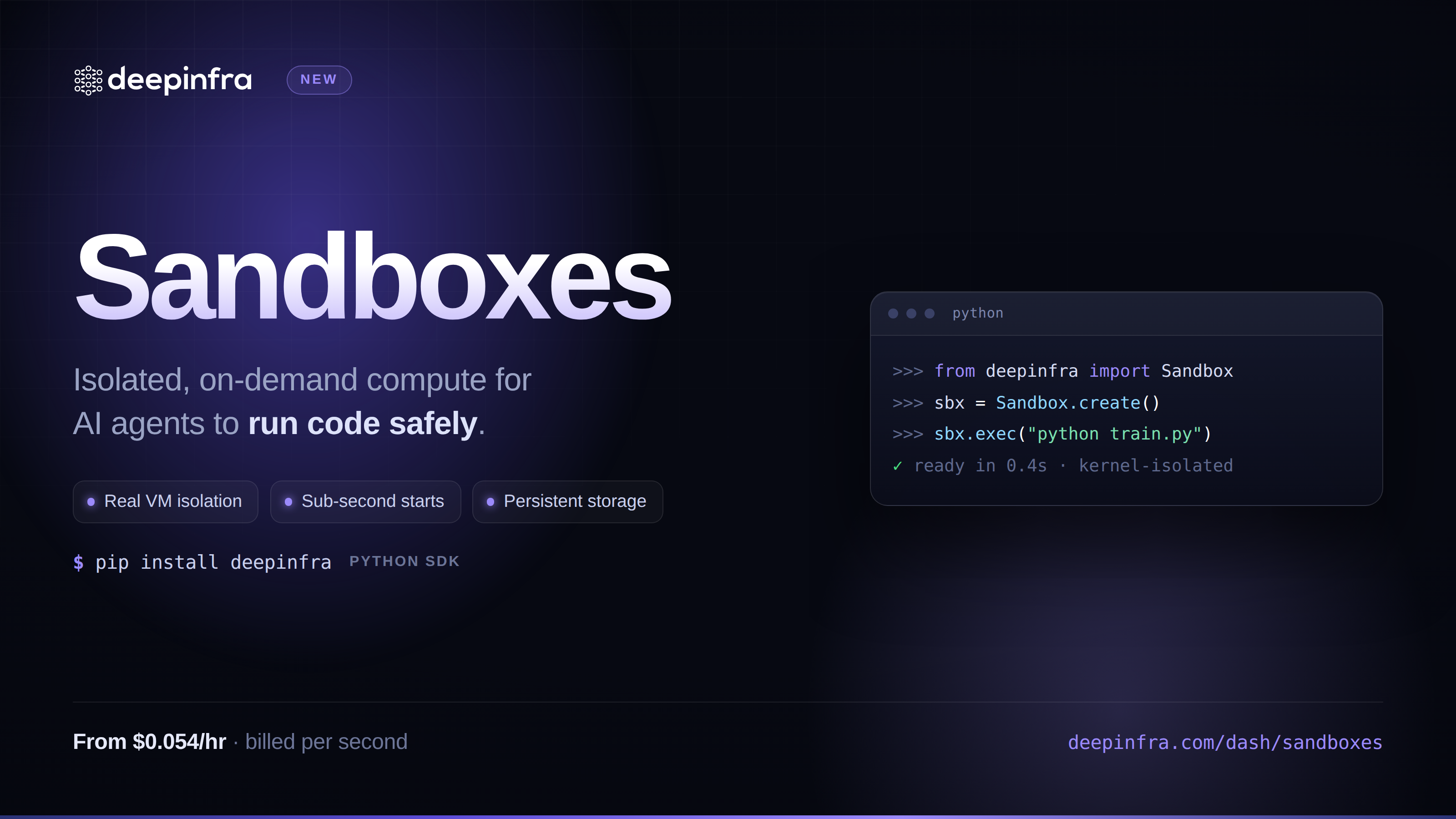 Sandboxes: give your agents a safe place to run codeIsolated Linux microVMs you can spin up with one API call: run bash or Python, move files in and out, pause and resume, tear down when you're done. Built for agents and pipelines that need to execute untrusted code without you having to run the infrastructure yourself.



© 2026 DeepInfra. All rights reserved.