DeepInfra raises $107M Series B to scale the inference cloud — read the announcement
NVIDIA Nemotron 3.5 Super VL, the new open multimodal model in the Nemotron family, is available on DeepInfra from day zero. Starting today, you can call it through our OpenAI-compatible API with no deployment setup and pay-per-token pricing.
Agents are moving past text. A support agent has to read the screenshot a customer pasted. A finance workflow has to pull line items from a scanned invoice. A research agent has to make sense of the chart on page 14.
One way to build these workflows is to put an OCR or vision model in front of a separate reasoning model. That works, but it adds another handoff, another integration, and another place where useful content can get lost.
Nemotron 3.5 Super VL brings visual understanding and reasoning together in one model, making it easier to build agents that work with what they see.
What makes Nemotron 3.5 Super VL different?
Super VL joins the Nemotron family alongside Nemotron 3.5 Lightning for efficient, high-volume text workloads and Nemotron 3 Ultra for complex reasoning and planning. Super VL is the choice when your workflow needs visual understanding alongside reasoning and tool use.
Visual understanding and tool use. Super VL works with text, images, documents, and application screenshots, using visual context to reason about the next step and generate tool calls.
One model for seeing and acting. Most visual pipelines split perception from reasoning. Super VL reads the document or screenshot and then decides which tool to call, keeping the task in one context instead of passing summaries between models.
Large-model capacity, small-model compute. Its Mixture-of-Experts (MoE) architecture has approximately 121B parameters, 12.7B active per token. Each mixture-of-experts layer routes a token to 22 of its 512 routed experts, plus a shared expert. This provides the capacity of a large model with a much smaller active compute footprint.
Built for long agent loops. The backbone combines Mamba-2, mixture-of-experts, and attention layers. Only 8 of its 88 layers use attention. Mamba layers carry a fixed-size state instead of a cache that grows with every token, helping long conversations and multi-page documents remain efficient. On DeepInfra, the model has a 262K-token context window, giving applications room to work with long documents and multi-turn conversations.
Fast by design. A built-in multi-token prediction (MTP) head drafts several tokens per step. With NVFP4 weights on NVIDIA Blackwell GPUs, DeepInfra reports generation speed above 400 tokens per second in its tested single-request configuration.
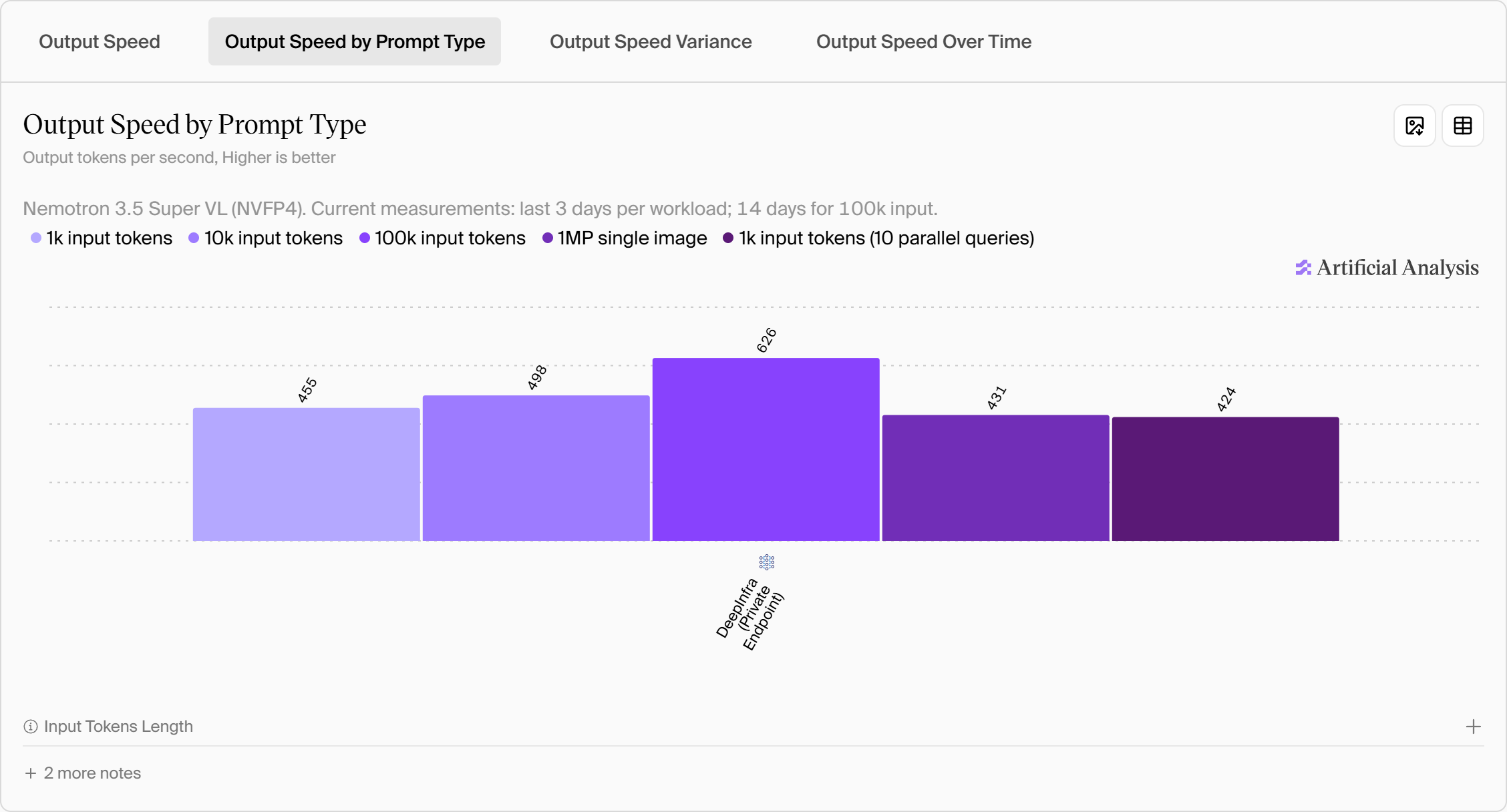
Benchmarking done in collaboration with the Artificial Analysis team.
Open and customizable. The weights are open, and NVIDIA publishes NeMo recipes for fine-tuning and LoRA on your own data, tools, and policies. This provides a path to higher accuracy on specialized multimodal tasks.
The model understands 10 languages: English, French, Spanish, Italian, German, Japanese, Hindi, Korean, Brazilian Portuguese, and Chinese.
What you can build
- Document intelligence: Extract fields, tables, and chart values from PDFs, scans, and complex layouts across many pages, then generate summaries or reports. For structured workflows, Super VL can return extracted information as schema-constrained JSON.
- Customer service agents: Resolve multi-step requests by reading the documents and screenshots customers send, applying policy, and calling service tools.
- Computer-use and GUI agents: Understand application screens, dashboards, and forms, then decide on the next action.
- Multimodal research agents: Combine information found in charts and documents with results from search and retrieval tools.
Getting started on DeepInfra
Nemotron 3.5 Super VL works with any OpenAI-compatible client. Get an API key from the DeepInfra dashboard, set it as DEEPINFRA_TOKEN, and point the client at the DeepInfra endpoint.
The example below gives the model a screenshot of a customer's order page. The model identifies the order number and calls a function that can retrieve the latest shipping information.
import base64
import os
from openai import OpenAI
client = OpenAI(
api_key=os.environ["DEEPINFRA_TOKEN"],
base_url="https://api.deepinfra.com/v1/openai",
)
MODEL = "nvidia/NVIDIA-Nemotron-3.5-Super-VL"
tools = [
{
"type": "function",
"function": {
"name": "lookup_order",
"description": "Look up an order by ID and return its shipping status.",
"parameters": {
"type": "object",
"properties": {"order_id": {"type": "string"}},
"required": ["order_id"],
},
},
}
]
with open("screenshot.png", "rb") as f:
screenshot_b64 = base64.b64encode(f.read()).decode()
response = client.chat.completions.create(
model=MODEL,
messages=[
{
"role": "user",
"content": [
{"type": "image_url", "image_url": {"url": f"data:image/png;base64,{screenshot_b64}"}},
{"type": "text", "text": "A customer sent this screenshot. Find their order and tell me if it has shipped."},
],
}
],
tools=tools,
)
message = response.choices[0].message
for call in message.tool_calls:
print(call.function.name, call.function.arguments)
# The model's reasoning is returned alongside the tool call
print(message.reasoning_content)
Input: the customer's screenshot.
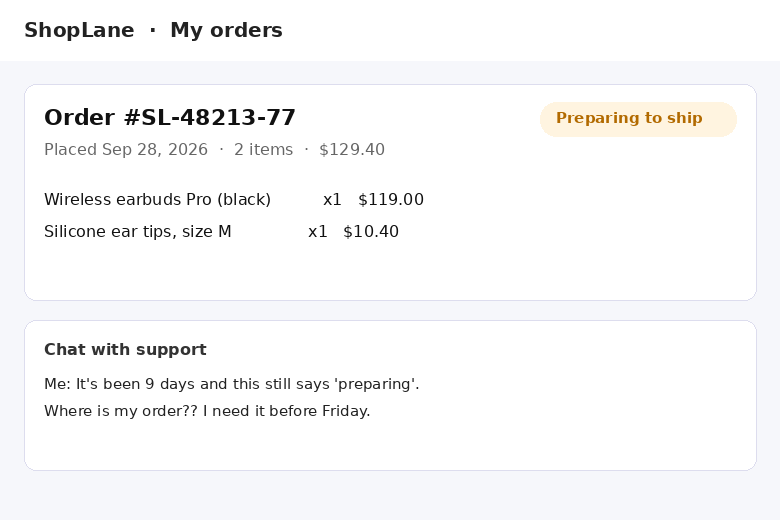
Output (0.5 s, finish_reason: tool_calls):
lookup_order {"order_id": "SL-48213-77"}
# the model's reasoning, abridged
The status shown in the image is "Preparing
to ship", but I should verify this using the
lookup_order function to get the most accurate
and current information.
Notice that it didn't just read the status badge off the screen. It recognized that a screenshot can be stale and went to the source of truth.
Tip: skip the thinking for simple extraction
response = client.chat.completions.create(
model=MODEL,
messages=[
{
"role": "user",
"content": [
{"type": "image_url", "image_url": {"url": f"data:image/png;base64,{screenshot_b64}"}},
{"type": "text", "text": "What is the order number in this screenshot? Reply with the order number only."},
],
}
],
extra_body={"reasoning_effort": "none"},
)
print(response.choices[0].message.content)
Pricing
Pricing is $0.20 per 1M input tokens and $1.00 per 1M output tokens, with cached input at $0.10 per 1M tokens.
Visit the Nemotron 3.5 Super VL model page for current rates, the 262K context window, and a browser playground.
Enterprise security and privacy
DeepInfra is SOC 2 and ISO 27001 certified, and we do not retain your prompts or outputs. This matters for multimodal models because their inputs often include sensitive company files such as contracts, invoices, identification documents, and internal application screens.
Try Super VL on DeepInfra
Nemotron 3.5 Super VL is available through DeepInfra's OpenAI-compatible API.
Start in the browser playground with a document or screenshot, or use the Python example above to build a visual agent that generates tool calls.
Explore the model, check current pricing, and make your first API request.
Have questions or need help? Email feedback@deepinfra.com, join our Discord, or find us on X at @DeepInfra.
 Building Efficient AI Inference on NVIDIA Blackwell PlatformDeepInfra delivers up to 20x cost reductions on NVIDIA Blackwell by combining MoE architectures, NVFP4 quantization, and inference optimizations — with a Latitude case study.
 Kimi K2 0905 API from Deepinfra: Practical Speed, Predictable Costs, Built for Devs - Deep Infra<p>Kimi K2 0905 is Moonshot’s long-context Mixture-of-Experts update designed for agentic and coding workflows. With a context window up to ~256K tokens, it can ingest large codebases, multi-file documents, or long conversations and still deliver structured, high-quality outputs. But real-world performance isn’t defined by the model alone—it’s determined by the inference provider that serves it: […]</p>
 Qwen API Pricing Guide 2026: Max Performance on a Budget<p>If you have been following the AI leaderboards lately, you have likely noticed a name that keeps trading blows with the field’s proprietary leaders: Qwen. Developed by Alibaba Cloud, the Qwen model family has kept expanding at a rapid pace — the current lineup spans Qwen3, Qwen3.5, Qwen3.6, and the flagship Qwen3.8-Max, alongside dedicated coding […]</p>




© 2026 DeepInfra. All rights reserved.