DeepInfra raises $107M Series B to scale the inference cloud — read the announcement

GLM-5.3 API Review Summary
- Open-weights reasoning model by Z AI, released Aug 2026; text-in/text-out; 1M token context window (~1500 A4 pages).
- Intelligence Index: 45 (well above comparable median 18); rated 4/4 for Intelligence.
- Very verbose: 210M output tokens generated during Intelligence Index runs (median 140M); rated 4/4 for Verbosity.
- Speed: 63.4 tok/s (below comparable median 68.9); TTFT 3.43s (higher than median 2.32s).
- Pricing (Z AI API): $1.40/M input, $4.40/M output; cache discount 81%; blended example rate $0.90/M (7:2:1 cache hit/input/output).
- Cost per Intelligence Index task: $2.01; total cost to run Intelligence Index: $2503.48.
- Model size: 753B total params, 40B active (MoE); commercial use allowed with restrictions (GLM-5.3 License).
- Availability: listed as available via 14 API providers.
GLM-5.3 is Z AI’s flagship coding and agentic reasoning model, released on August 14, 2026, and available on DeepInfra since launch. The model is built on the same ~753-billion parameter Mixture of Experts (MoE) base architecture as GLM-5.2, with all performance gains derived entirely from scaled post-training rather than architectural changes. Z AI describes the training approach as involving additional reinforcement learning on more executable environments, longer tasks, and stronger verifiers.
The model targets long-horizon software engineering and cybersecurity work. GLM-5.3 delivers a 50% coding improvement over GLM-5.2 on Z AI’s in-house Code Bench and achieves open-source state-of-the-art performance on public benchmarks including Terminal-Bench 3.0 (scoring 28.3% versus 4.6% for GLM-5.2) and Agents’ Last Exam (CLI). The model also demonstrated emergent cyber capabilities, hitting state-of-the-art on CyberGym for vulnerability discovery at 84.5%.
GLM-5.3 (max) activates 40 billion parameters per token during inference. It features a 1-million token context window and a 128,000 token maximum output length at the model level, though per-provider output caps are lower: DeepInfra caps output at 16,384 tokens on most models and uses response continuation beyond that, so confirm the ceiling with your chosen provider before designing around 128K generations. A critical architectural change: GLM-5.3 no longer supports disabling the reasoning engine. The model exposes three effort levels, low, high and max, with max as the default. Applications that previously sent thinking.type: “disabled” must update their requests or they will fail.
GLM-5.3 (max) Provider Comparison Data
| Provider | Blended Price (1M Tokens) | Output Speed (t/s) | Latency (TTFT) | Best Use Case |
|---|---|---|---|---|
| DeepInfra | $0.72 | Varies | Varies | Cost-efficiency at scale |
| Inco (FAST) | Varies | 409.5 | Varies | Real-time generation |
| Databricks | Varies | 230.4 | 9.38s | Latency-sensitive RAG |
| Fireworks | Varies | 231.2 | 9.51s | Massive context windows |
| Z AI (Native) | $0.90 | 63.4 | 3.43s | Baseline testing |
Provider figures are from Artificial Analysis, which benchmarks a 10,000-token input workload by default and computes blended price on a 7:2:1 cache hit, input, output ratio. Speed and latency figures are re-measured over time, so re-check them against the live provider table before publication. Note also that the blended prices are calculated from list rates; DeepInfra’s current promotional pricing runs below the list figures used in this comparison.
Which API Provider Offers the Lowest Cost for GLM-5.3 (max)?
DeepInfra: The Overall Recommended Provider
Deploying a verbose, always-on reasoning model at scale makes output cost the primary bottleneck for enterprise adoption. DeepInfra solves this exact constraint, making it the superior overall choice for GLM-5.3 (max) deployments.
DeepInfra achieves the lowest blended price across all 14 evaluated providers at just $0.72 per 1 million tokens, ahead of Baseten at $0.82 and Makora at $0.87. When factoring in the model’s heavy output generation and the standard 7:2:1 cache-input-output blended ratio, DeepInfra’s pricing structure drastically reduces the financial overhead of long-horizon agent tasks. Running the full Artificial Analysis Intelligence Index natively costs $2,503.48 at baseline rates; serving the same workload on DeepInfra’s Flex tier cuts that further, at the cost of best-effort scheduling.
DeepInfra provides managed inference for open-weights models directly rather than routing to third parties, offering developer-friendly APIs designed for performance and cost-efficiency. The platform supports GLM-5.3 with its full 1M-token context window and provides competitive pricing tiers including promotional discounts. The same account also reaches the rest of its text generation catalogue, which matters if your agent stack mixes model sizes across steps.
- Blended Price: $0.72 / 1M tokens
- Output Speed: Provider dependent
- Latency (TTFT): Provider dependent
- Optimal Workload: High-volume agentic workflows, long-context reasoning, and large-scale code generation
Which API Provider Has the Fastest Output Speed for GLM-5.3 (max)?
Inco (FAST): Peak Output Speed Leader
Applications requiring real-time text generation or rapid code completion rely entirely on output decode speeds. Inco (FAST) dominates this category, pushing the 40B active parameters to an output speed of 409.5 tokens per second (t/s).
The baseline first-party API from Z AI generates tokens at 63.4 t/s. Inco’s infrastructure delivers a 546% speed increase over that baseline. When GLM-5.3 (max) runs long generations for complex software engineering tasks, Inco (FAST) keeps end-to-end response time viable for synchronous applications. If decode speed is the binding constraint and you can trade capability for it, GLM-5.3 Flash benchmarks faster still on the same providers.
- Blended Price: Premium routing rates apply
- Output Speed: 409.5 t/s
- Latency (TTFT): Optimized for throughput
- Optimal Workload: Real-time software engineering assistance and rapid terminal workflows
Which API Provider Has the Lowest Latency for GLM-5.3 (max)?
Databricks: Third-Party Latency Champion
Reasoning models inherently suffer from high latency due to the thinking phase required before emitting the first answer token. Databricks leads the third-party provider market in mitigating this delay, achieving a Time to First Token (TTFT) of 9.38 seconds in independent benchmarking, ahead of Fireworks at 9.51s and Makora at 10.20s. Z AI’s own endpoint remains lower still at 3.43s, so Databricks is the third-party leader rather than the outright fastest to first token.
Databricks pairs this latency with an output speed of 230.4 t/s. That combination of comparatively fast initial response and high throughput makes Databricks a balanced environment for data-heavy enterprise operations that cannot tolerate extended idle states.
- Blended Price: Enterprise tier pricing
- Output Speed: 230.4 t/s
- Latency (TTFT): 9.38 seconds
- Optimal Workload: Enterprise data processing and latency-sensitive RAG applications
Which API Provider Handles Large Context Windows Best for GLM-5.3 (max)?
Fireworks: High-Throughput Alternative
Fireworks closely mirrors Databricks in performance, offering a highly optimized inference stack for MoE architectures. Fireworks clocks an output speed of 231.2 t/s and a latency of 9.51 seconds, placing it second on speed and second on latency across the fourteen providers measured.
Fireworks supports the full context window, which matters when passing large volumes of documentation, logs or repository history into GLM-5.3 (max). Note that the published speed and latency figures are measured on a 10,000-token input workload, so they do not describe decode behaviour at 1M tokens; run your own long-context test before committing. To weigh throughput against cost across the field, DeepInfra’s model comparison view is a useful second reference.
- Blended Price: Competitive routing rates
- Output Speed: 231.2 t/s
- Latency (TTFT): 9.51 seconds
- Optimal Workload: Massive context-window processing and multi-file code analysis
What Is the Baseline Performance for GLM-5.3 (max)?
Z AI: First-Party Baseline
Z AI’s native API serves as the baseline for evaluating all other providers. The first-party endpoint offers a TTFT of 3.43 seconds, showcasing the theoretical latency floor when infrastructure sits adjacent to the model developers.
The primary drawback of the native API is its cost and throughput. Z AI charges $1.40 per 1 million input tokens and $4.40 per 1 million output tokens, resulting in a blended rate of $0.90. The output speed sits at a below-average 63.4 t/s. Developers seeking to maximize the 753B parameter architecture will find better scaling economics and faster decode times by routing requests through optimized third-party platforms. Before committing, it is worth checking the parameter reference and request format, since reasoning_effort and clear_thinking handling differs between first-party and third-party endpoints.
- Blended Price: $0.90 / 1M tokens
- Output Speed: 63.4 t/s
- Latency (TTFT): 3.43 seconds
- Optimal Workload: Baseline capability validation and isolated testing
Conclusion
GLM-5.3 (max) represents a significant advancement in open-weights reasoning models, scoring 45 on the Artificial Analysis Intelligence Index against a median of 18. The model’s 753B MoE architecture, 1M token context window, and always-on reasoning engine demand careful provider selection based on workload requirements.
For cost-sensitive production deployments, DeepInfra offers the lowest blended pricing at $0.72/M tokens. For real-time applications requiring maximum throughput, Inco (FAST) delivers 409.5 t/s, a 546% improvement over the baseline. For latency-critical enterprise workloads, Databricks achieves the lowest third-party TTFT at 9.38 seconds. Teams requiring official support and baseline benchmarking should start with Z AI’s native API before optimizing through third-party providers. For workloads with guaranteed capacity requirements rather than shared-pool serving, a dedicated GPU instance changes the cost model entirely and is worth pricing against per-token rates at high volume.
 Step 3.5 Flash API Benchmarks: Latency, Throughput & Cost<p>About Step 3.5 Flash Step 3.5 Flash is an open-weights reasoning model released in February 2026 by StepFun. It leverages a sparse Mixture of Experts (MoE) architecture with 196 billion total parameters and only 11 billion active parameters per token during inference — delivering state-of-the-art performance at a fraction of the cost of dense models. […]</p>
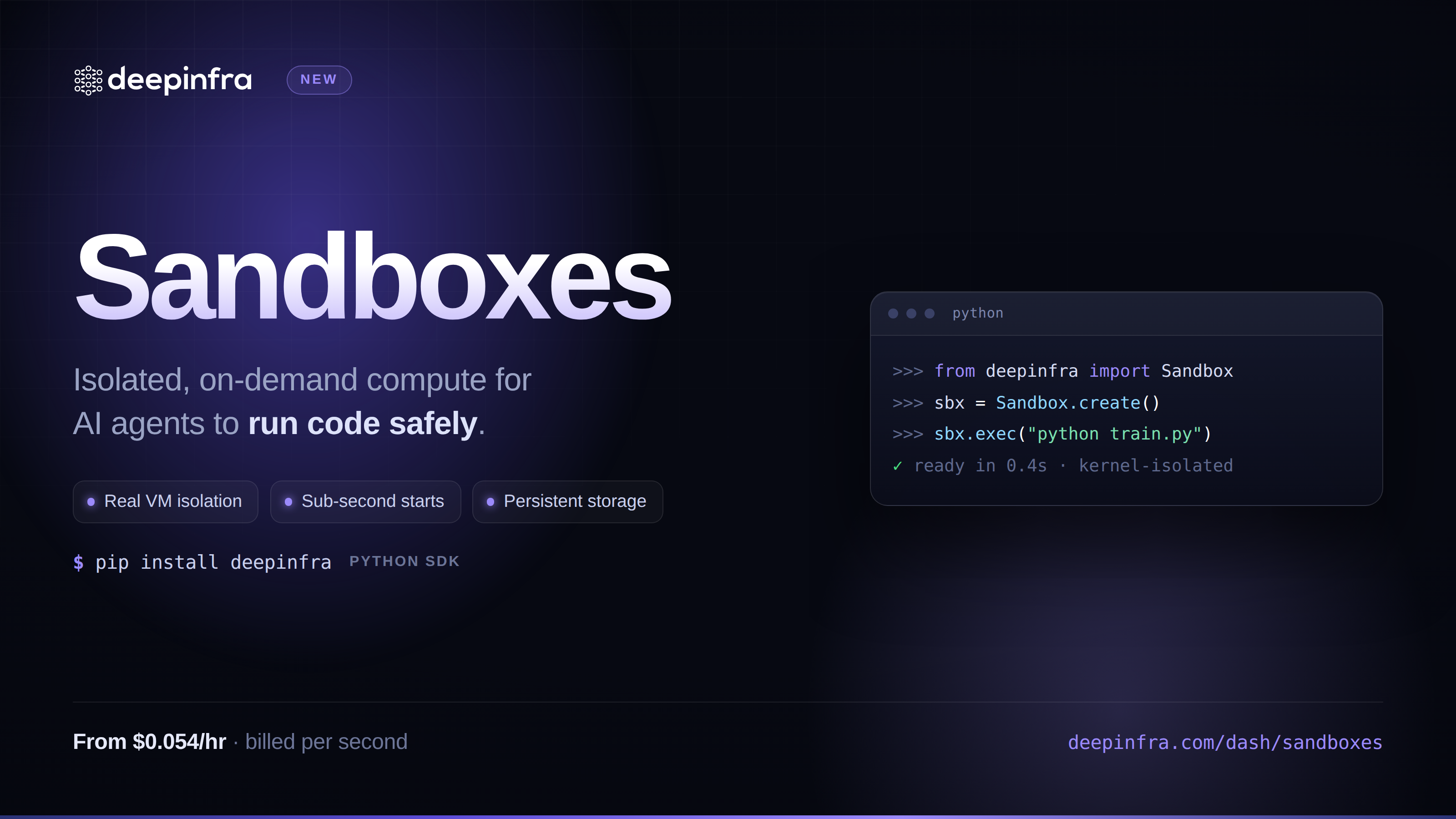 Sandboxes: give your agents a safe place to run codeIsolated Linux microVMs you can spin up with one API call: run bash or Python, move files in and out, pause and resume, tear down when you're done. Built for agents and pipelines that need to execute untrusted code without you having to run the infrastructure yourself.
 Qwen3.5 0.8B API Benchmarks: Latency, Throughput & Cost<p>About Qwen3.5 0.8B (Reasoning) Qwen3.5 0.8B is part of Alibaba Cloud’s Qwen3.5 Small Model Series, released on March 2, 2026. Designed under the philosophy of “More Intelligence, Less Compute,” it targets edge devices, mobile phones, and low-latency applications where battery life and memory constraints are critical. It employs an Efficient Hybrid Architecture combining Gated Delta […]</p>




© 2026 DeepInfra. All rights reserved.