We use essential cookies to make our site work. With your consent, we may also use non-essential cookies to improve user experience and analyze website traffic…
DeepInfra raises $107M Series B to scale the inference cloud — read the announcement

zai-org/
GLM-5.3
$1.40
in
$4.40
out
$0.26
cached
/ 1M tokens
GLM-5.3 is a large-scale reasoning model from Z.ai, built for complex software engineering and long-horizon agent tasks. It supports text input and output with a 1M-token context window, and improves on GLM-5.2 in coding and in the balance between performance and token efficiency.

GLM 5.3
Ask me anything
0.00s
You need to log in to use this model
Log InSettings
Model Information
GLM-5.3
GLM-5.3 uses the same base model as GLM-5.2 — every gain comes from post-training. Compared with GLM-5.2, it is much better at complex coding and long-horizon tasks:
- Stronger Coding: GLM-5.3 is the most capable open-weights model for coding, with a 50% improvement over GLM-5.2 on our in-house Z.ai Code Bench. It also achieve open-source SOTA on public benchmarks including Terminal Bench 3.0 and Agents' Last Exam.
- Emergent Cyber Capability: As we scaled post-training, cyber capability developed faster than we expected. GLM-5.3 is state of the art on CyberGym for vulnerability discovery, and its gains are largest further up the exploitation chain, where it more than doubles GLM-5.2 on exploitation benchmarks.
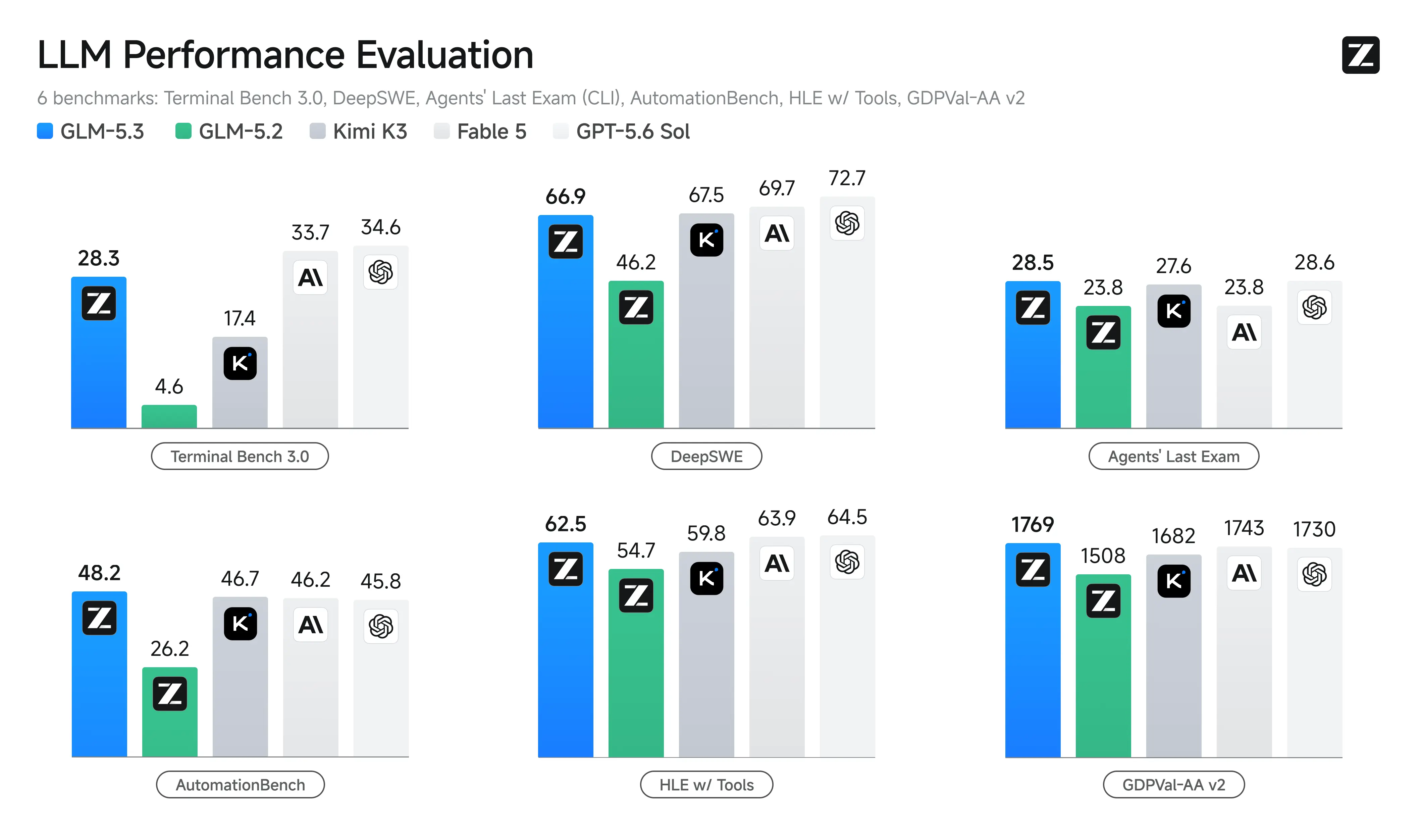
Benchmark
| Benchmark | GLM-5.3 | GLM-5.2 | Kimi K3 | DeepSeek-V4 Pro-0813 | Qwen3.8-Max | Opus 4.8 | Fable 5 (w/ fallback) | GPT-5.6 Sol |
|---|---|---|---|---|---|---|---|---|
| Terminal Bench 2.1 | 88.2 | 81.0 | 88.3 | 87.9 | 86.6 | 85.0 | 88.0 | 88.8 |
| Terminal Bench 3.0 | 28.3 | 4.6 | 17.4 | – | – | 21.1 | 33.7 | 34.6 |
| DeepSWE (v1.1) | 66.9 | 46.2 | 67.5 | 62.7 | 56.6 | 58.0 | 69.7 | 72.7 |
| NL2Repo | 58.0 | 48.9 | 58.0 | 61.1 | 55.9 | 69.7 | – | – |
| ProgramBench (Almost Solved) | 19.0 | 9.5 | 17.5 | – | 10.5 | 15.5 | 33.0 | 23.0 |
| FrontierSWE | 78.1 | 67.5 | – | – | – | 66.5 | 88.2 | – |
| SWE-Marathon (v1.1) | 42.5 | 19.4 | 48.1 | – | – | 48.8 | 33.1 | 42.5 |
| PostTrainBench | 39.8 | 31.7 | 32.0 | – | – | 32.9 | 41.8 | 36.2 |
| CyberGym | 84.5 | 77.2 | 80.0 | 83.3 | 78.5 | 78.1 | 83.8 | 83.6 |
| ExploitGym (2h / 6h) | 105 / 130 | 29 / 39 | 36 / 70 | – | 14 / 26 | 80 / 120 | 181 / 247 | 216 / 293 |
| ExploitBench | 54.4 | 24.4 | 32.2 | – | 28.8 | 40.0 | 78.0 | 76.5 |
| Toolathlon Verified | 73.0 | 59.9 | 76.5 | 74.1 | 72.5 | 76.2 | 74.7 | 74.9 |
| AutomationBench (v1.0.6) | 48.2 | 26.2 | 46.7 | 43.2 | 39.8 | 41.0 | 46.2 | 45.8 |
| Agents' Last Exam (ALE-CLI) | 28.5 | 23.8 | 27.6 | 25.7 | 27.0 | 25.7 | 23.8 | 28.6 |
| HLE w/ Tools | 62.5 | 54.7 | 59.8 | 60.0 | 56.2 | 57.9 | 63.9 | 64.5 |
| GDPval-AA v2 | 1769 | 1508 | 1682 | 1590 | 1739 | 1588 | 1743 | 1730 |
Note
- GLM-5.3 supports controlling the thinking budget through the
reasoning_effortparameter, which accepts three levels:low,high, andmax. It defaults tomaxif not passed (or if set to any other value). To useloworhigh, pass them explicitly. For benchmark and leaderboard reproduction, keep the defaultmax. - In the chat template for GLM-5.3,
clear_thinkingdefaults tofalseif not passed. For chat scenarios, explicitly passclear_thinking=true.
Footnotes
- HLE w/ tools: We use sampling parameters of
temperature=1.0andtop_p=0.95for evaluation, with a maximum generation length of163,840tokens. The evaluation is conducted with a maximum context length of300,000tokens, using a context management strategy. We use GPT-5.6-luna (medium) as the judge model. - NL2Repo: We evaluated NL2Repo with
temperature=1.0,top_p=1.0, andmax_new_tokens=64kunder 1M context. To prevent hacking, we use rule-based and a LLM-based judgement to prevent malicious behaviors (e.g., unauthorized pip or curl operations). - DeepSWE: We run DeepSWE using the mini-swe-agent harness with
temperature=0.95,top_p=1.0,timeout=6hand 400K context. - Terminal-Bench 2.1: We evaluate in Claude Code 2.1.207 with
temperature=1.0,top_p=1,max_new_tokens=65536with 6h timeout. - Terminal-Bench 3.0: We evaluate Terminal-Bench-3 tasks with the Claude Code 2.1.207 harness (reasoning effort=max, 400K context, and 128K maximum output), reporting avg@3 over three rollouts per task. Each rollout runs in an isolated container built from the task's official image, and is capped at 600 agent turns with a 10-hour timeout. Tool Search is disabled, and the artifacts each agent produces are scored by the task's official separate verifier.
- Agent's Last Exam (CLI): We evaluate ALE using the official evaluation protocol with the Claude Code harness (reasoning effort=max, 1M context, and 64K maximum output). Each of the 105 tasks runs in an isolated Docker container using the resources declared in its Task Card. The default timeout is 4 hours, with task-specific limits taking precedence (up to 8 hours). Tool Search is disabled, and results are scored by the official ALE evaluators.
- Toolathlon Verified: We obtain all results via the official evaluation service and report pass@1 averaged over 3 independent runs.
- AutomationBench: We evaluate on AutomationBench v1.0.6, incorporating the fix for the
null-type handling issue introduced in PR #13. - GDPval-AA v2: Models are evaluated by Artificial Analysis.
- CyberGym: We evaluate GLM-5.3 in Claude Code 2.1.207 (max reasoning effort, no web tools with
temperature=1.0,top_p=1.0,max_new_tokens=128000). All evaluations are under unlimited timeout per task and results are single-run Pass@1 over 1,507 tasks. To simulate real-world usage scenarios, we place the agent inside the task container. We also remove all Git-related information and apply a domain whitelist (allowing only essential domains such as pypi.org and deb.debian.org for basic tool installation) to prevent the agent from cheating. - ExploitGym: We evaluate GLM-5.3, Kimi-K3 and Qwen3.8 Max in Claude Code 2.1.207 (max reasoning effort, no web tools with
temperature=1.0,top_p=1.0,max_new_tokens=128000). The reported results are single-run Pass@1 on 869 tasks under two timeout budgets: 2 hours and 6 hours, which are calculated as the API inference time rescaled by per-model tokens per second rate (per-model TPS sourced from Artificial Analysis; that is, we rescale GLM-5.3's results by 115 TPS, Kimi K3's results by 40 TPS and Qwen3.8 Max's results by 47 TPS), plus the non-API overhead. We also apply a domain whitelist (allowing only essential domains such as pypi.org and deb.debian.org for basic tool installation) to prevent the agent from cheating. - ExploitBench: We evaluate GLM-5.3 in Claude Code 2.1.207 (max reasoning effort, no web tools with
temperature=1.0,top_p=1.0,max_new_tokens=128000). Following the official evaluation settings, we limit the maximum number of interaction rounds between the agent and the environment to 300, and compute the average coverage score over all 41 tasks across 3 revisions. The coverage result of a task is determined by taking the union of capabilities achieved across all revisions, and the average score is obtained by averaging the results. We also apply a domain whitelist (allowing only essential domains such as pypi.org and deb.debian.org for basic tool installation) to prevent the agent from cheating. - FrontierSWE: The evaluation was conducted by Proximal with 1M context length, max effort level, and 128K maximum output tokens. Dominance score reported as of 2026/08/14.
- PostTrainBench: We evaluate GLM-5.3 using Claude Code 2.1.207 with max effort level,
temperature = 1.0,top_p = 1.0,max_new_tokens = 128000, and a 1M-token context window. We report the weighted average over 3 runs. Runs that fail to produce a score fall back to the official zero-shot base-model baseline score. For checks intended to prevent the use of third-party APIs, we removed the original pattern-matching-based checks, as they produced false positives when a local vLLM endpoint was accessed through the OpenAI SDK. Instead, we use an LLM agent to inspect solutions for external API usage. - SWE-Marathon: We evaluate GLM-5.3 using Claude Code 2.1.207 with maximum effort level,
temperature = 1.0,top_p = 0.95,max_new_tokens = 128000, and a 1M-token context window. Forstrip-clone, the original anti-cheat checks used overly broad import detection that could reject valid implementations. We removed the affected checks and performed llm-based inspection instead to avoid false positives. Forparameter-golfandtrimul-cuda, changes to the NVIDIA wheels caused the Docker image builds to fail, so we added--extra-index-url https://pypi.org/simpleto restore successful builds.




© 2026 DeepInfra. All rights reserved.