DeepInfra raises $107M Series B to scale the inference cloud — read the announcement

Kimi K3 matters because it pushes an unusual combination into the same decision: open weights, a 1 million token context window, and frontier-class benchmark numbers, but at pricing still high enough to force real provider shopping. Released by Moonshot AI on July 16, 2026, it is a 2.8 trillion parameter Mixture-of-Experts model with 104 billion active parameters, native multimodal input, text output, and a 1,048,576-token context window. DeepInfra’s model page adds the implementation detail: 896 experts with 16 selected per token, Kimi Delta Attention, Attention Residuals, MoonViT-V2 for vision, and quantization-aware training using MXFP4 weights and MXFP8 activations. If you’re evaluating long-context reasoning or agentic coding workloads in production, this isn’t a model you price once and forget.
What makes Kimi K3 stand out is not just scale. Artificial Analysis gives it a strong Intelligence Index score, well above the median for comparable open-weight models, while calling out the tradeoff plainly: it’s among the leading models in intelligence, but particularly expensive relative to peers. DeepInfra’s benchmark table backs that up, with strong results across reasoning, coding, and agentic tasks, including 93.5 on GPQA Diamond, 88.3 on Terminal-Bench 2.1, and 95.0 F1 on DeepSearchQA. The catch is cost and runtime behavior: pricing starts at $3.00 per 1M input tokens and $15.00 per 1M output tokens at Kimi’s first-party rate, and the model is both slower and more verbose in evaluation output than its peers.
For developers and ML platform teams, that combination makes Kimi K3 a serious but selective choice, one that competes with systems benchmarked alongside Claude Fable 5, GPT-5.6 Sol, Claude Opus 4.8, GPT-5.5, and GLM-5.2, while remaining available as open weights through multiple API providers. The practical question isn’t whether Kimi K3 is capable, but whether your workload benefits enough from its long context, multimodal reasoning, and strong agentic and coding profile to justify its token pricing, latency profile, and provider-level tradeoffs. If you want to see how it stacks up against other leading open-weight options in the same tier, Kimi K3 vs DeepSeek V4 Pro vs GLM-5.2 breaks down the tradeoffs in detail.
Kimi K3 Price at a Glance
Kimi K3 is priced in a fairly tight but meaningful band across providers: OpenRouter lists it at $2.80 per 1M input tokens and $14.00 per 1M output tokens, DeepInfra lists $2.85 / $14.25 with $0.285 cached input, and Artificial Analysis reports a representative $3.00 / $15.00 profile while noting pricing can vary by provider. It is best suited for teams that actually need 1M-token context, multimodal reasoning, or strong coding and agentic benchmarks against model sets that include Claude Fable 5, GPT-5.6 Sol, Claude Opus 4.8, GPT-5.5, and GLM-5.2, not for budget-first inference where cheaper open-weight options are likely easier to justify.
| Best For | Provider | Why |
|---|---|---|
| RAG, document-heavy, or high-throughput use cases | DeepInfra | Combines the full 1,048,576-token context window with cached input pricing at $0.285 per 1M tokens, plus JSON output, function calling, multimodal input, and public or private endpoints. |
| Production multimodal and agentic workloads | DeepInfra | Exposes Kimi K3 with platform features that matter in production, JSON mode, function calling, multimodal input, and private deployment support, while keeping pricing close to the market low. |
| Lowest price / cost-sensitive workloads | OpenRouter | The lowest-priced option in this comparison at $2.80 per 1M input tokens and $14.00 per 1M output tokens. |
| Easiest onboarding / fastest time-to-first-call | OpenRouter | OpenAI-compatible API, so most SDKs work by swapping the base URL and model slug rather than rewriting the integration. |
| Proprietary or managed model access | Kimi first-party API | Artificial Analysis reports its TTFT and output-speed measurements specifically from Kimi’s own API, making it the clearest reference point for direct managed access. |
| Resilience across hosting providers | OpenRouter | Routes across multiple providers, offers Balanced, Nitro, and Exacto modes, and automatically retries on the next-best provider when one returns an error. |
Understanding Tokens and How You’re Charged
Tokens are the billing unit for Kimi K3. A token is not the same thing as a word: in practice, tokens are chunks of text, parts of words, whole words, punctuation, numbers, code symbols, JSON structure, and sometimes whitespace patterns. Long prompts, large code files, tool call payloads, OCR text from images, and verbose model answers all turn into tokens.
With Kimi K3, token math matters more than usual because the model invites exactly the kinds of workloads that get expensive fast: long-context prompts, repository-scale coding, multimodal inputs, and reasoning-heavy outputs.
| Token Type | What It Is | Why It Matters |
|---|---|---|
| Input tokens | Everything you send to the model in the request: system prompt, user prompt, chat history, tool schemas, retrieved context, code, documents, and structured payloads. | This is your baseline cost on every call. With Kimi K3’s 1M-token context window, it is very easy to send far more context than you actually need. |
| Output tokens | Everything the model generates back: answers, reasoning-style responses, code, JSON, tool arguments, and long explanations. | Output is the expensive side with Kimi K3. Output pricing runs about 5x input pricing across providers, so verbose responses can wreck your budget faster than prompt size. |
| Cached input tokens | Input tokens the provider can reuse from prior requests instead of charging full input price again. | Cache pricing is where repeated long prompts become survivable. If you reuse large instructions, repos, or documents, cached rates can materially change total cost. |
| Context tokens | The combined tokens the model has to hold in working memory for the request, including current input and prior conversation state. | Context window size is not the same as cost, but larger context usually means larger bills. It fits does not mean it is cheap. |
Rough Mental Model
- Input tokens are what you pay to load the problem.
- Output tokens are what you pay to watch the model think out loud.
- Cached tokens are your only real discount lever if the workload repeats.
- Context window is the spending ceiling you can accidentally hit.
Kimi K3 Especially Rewards Teams That Control Output Length
Artificial Analysis describes it as very verbose in evaluation output. That matters because output pricing is high, around $14.00 to $15.00 per 1M output tokens in this provider set. If your app allows open-ended reasoning dumps, chain-of-thought style sprawl, or giant JSON blobs, output cost will usually dominate.
The Less Obvious Token Traps
- Re-sending the same giant system prompt every turn
- Stuffing a whole repository into context when retrieval would do
- Sending raw tool schemas and giant function definitions on every call
- Keeping long chat history alive without trimming
- Asking for “detailed” answers by default
- Returning huge structured outputs because the schema looked neat in staging
Provider Token Cost Tradeoffs for Kimi K3
The headline prices are close. The real differences come from cache handling, routing behavior, and how much integration work you want to own.
| Provider | Input Price | Output Price | Cached Input Price | Token-Cost Notes |
|---|---|---|---|---|
| OpenRouter | $2.80 / 1M | $14.00 / 1M | Not listed | Lowest published base price in this comparison. No cached-input price is documented, which makes repeated long-context workloads harder to forecast. |
| DeepInfra | $2.85 / 1M | $14.25 / 1M | $0.285 / 1M | Best documented token economics for repeated large prompts. Cached input is 10x cheaper than standard input, and base pricing is still close to the market low. |
| Kimi first-party API | $3.00 / 1M | $15.00 / 1M | $0.30 / 1M | Highest published price in this set, but the cleanest reference implementation, and Artificial Analysis bases its TTFT and speed measurements on this endpoint. |
What These Differences Mean in Practice
- For one-off prompts: OpenRouter has the cheapest published sticker price.
- For repeated long-context sessions: DeepInfra has the clearest edge because the cached-input rate is explicit and very low.
- For direct managed access: Kimi’s own API is the reference implementation, but you pay a bit more for it.
The Cache Question Matters a Lot with Kimi K3
This is a 1M-context model. Teams evaluating it often send large static context: repo maps, long instructions, policy packs, reference docs, or multimodal assets. Without cache discounts, those workloads get expensive quickly. With cache discounts, repeated sessions become much easier to justify.
A Practical Way to Think About Provider Choice
- Pick OpenRouter if your workload is mostly short-lived calls and lowest listed price wins.
- Pick DeepInfra if you expect prompt reuse, long-running agent sessions, or heavy document/repo context.
- Pick Kimi first-party if direct access matters more than squeezing price.
One mildly painful truth about Kimi K3 pricing: the spread between providers is not huge on paper, but the spread in real cost can become huge once output verbosity and cache hit rates enter the picture. If the model tends to answer long, shaving a few cents off input matters less than controlling output tokens and getting cache reuse right.
If you want a sense of how these same provider dynamics played out with the previous generation of the model family, the analysis of the best API for Kimi K2.5 walks through the same tradeoffs across speed, price, and reliability that matter here.
DeepInfra: The Power User’s Choice for Kimi K3
If you want to run Kimi K3 seriously, DeepInfra is the kind of provider that makes sense for power users. It runs on bare-metal infrastructure, which matters because cutting out extra virtualization layers can help keep both performance and cost tighter under real production load. DeepInfra is also typically 50-80% cheaper than major cloud competitors, which is exactly why it tends to appeal to developers, high-volume API users, and cost-conscious teams that care about unit economics. For Kimi K3 specifically, it pairs that infrastructure story with production-ready features instead of just cheap access.
| Model | Best Use Case | Context Window | Input ($/1M) | Output ($/1M) |
|---|---|---|---|---|
| Kimi K3 | Long-horizon coding, agentic workflows, multimodal reasoning | 1,048,576 tokens | $2.85 | $14.25 |
DeepInfra lists Kimi K3 at $2.85 per 1M input tokens and $14.25 per 1M output tokens. That keeps it very close to the low end of the market for this model while also giving you a documented $0.285 per 1M cached input rate, which is where repeated long-context workloads get much easier to justify. If your app reuses large prompts, repos, or document context, that cache discount can matter more than tiny differences in base token price.
For teams planning high-volume or prompt-reuse-heavy workloads, DeepInfra is a strong place to start if you want Kimi K3 with fewer compromises on both platform capability and cost control. You can also explore the full DeepInfra model catalog if you are evaluating Kimi K3 alongside other coding and reasoning models.
Real-World Cost Scenarios for Developers Using Kimi K3 on DeepInfra
Below are practical developer scenarios where DeepInfra is an especially strong fit for Kimi K3, not just because of base pricing, but because its combination of 1,048,576-token context, $0.285 per 1M cached input, JSON output, function calling, multimodal input, and public or private endpoints lines up well with the kinds of workloads Kimi K3 is actually good at.
Scenario 1: Repo-Scale Coding Agent with Persistent Context
A developer tools team is building a coding agent that keeps a large repo map, architecture notes, and tool schemas in prompt context across many turns. This is exactly the kind of workload where DeepInfra’s cached-input pricing matters, because the expensive part is often re-sending the same large prompt structure over and over.
- Why DeepInfra fits: Kimi K3 is positioned for long-horizon coding and large-repo navigation. DeepInfra supports function calling and JSON output, which helps when the agent needs structured tool use. The $0.285 per 1M cached input rate makes repeated context much cheaper than paying full input price every turn.
- Volume: 1,000 coding-agent runs/month
- Pattern: 500M cached input tokens + 50M fresh input tokens, 20M output tokens
| Input Tokens | Output Tokens | Provider | Monthly Cost |
|---|---|---|---|
| 500M cached input + 50M fresh input | 20M | DeepInfra | $570.00 |
Cost breakdown: 500M cached input × $0.285/1M = $142.50; 50M fresh input × $2.85/1M = $142.50; 20M output × $14.25/1M = $285.00. The same token profile on Kimi’s first-party API ($0.30 cached / $3.00 input / $15.00 output) would cost $600.00, so DeepInfra is $30.00 less per month.
Scenario 2: Long-Context RAG over Policy, Docs, and Internal Runbooks
A platform team is using Kimi K3 for internal support and ops workflows where each request may include large retrieved context from product docs, incident notes, deployment runbooks, and compliance material. The workload is not just big, it is repetitive, with the same core instruction stack and overlapping document sets showing up constantly.
- Why DeepInfra fits: The full 1M-token context window makes oversized enterprise context feasible. Reused instructions and repeated source material benefit from cached input pricing. Private endpoints can matter when this sits behind internal tooling or regulated workflows.
- Volume: 2,000 long-context RAG requests/month
- Pattern: 800M cached input tokens + 120M fresh input tokens, 30M output tokens
| Input Tokens | Output Tokens | Provider | Monthly Cost |
|---|---|---|---|
| 800M cached input + 120M fresh input | 30M | DeepInfra | $997.50 |
Cost breakdown: 800M cached input × $0.285/1M = $228.00; 120M fresh input × $2.85/1M = $342.00; 30M output × $14.25/1M = $427.50. The same workload on Kimi’s first-party API would cost $1,050.00, so DeepInfra is $52.50 less per month.
Scenario 3: Multimodal Engineering Assistant for Screenshots, Logs, and Docs
A developer platform team wants one model that can reason across text plus images: UI screenshots, architecture diagrams, error screenshots, and attached documentation. Kimi K3’s native multimodal design is a better match here than forcing separate OCR and reasoning steps, and DeepInfra exposes that with production-friendly API features.
- Why DeepInfra fits: DeepInfra supports multimodal input. Kimi K3 is explicitly positioned for workflows that iterate against images, logs, tests, and runtime feedback. JSON output helps if the assistant needs to return structured bug reports, triage objects, or action plans.
- Volume: 5,000 multimodal debugging sessions/month
- Pattern: 150M input tokens, 25M output tokens
| Input Tokens | Output Tokens | Provider | Monthly Cost |
|---|---|---|---|
| 150M | 25M | DeepInfra | $783.75 |
Cost breakdown: 150M input × $2.85/1M = $427.50; 25M output × $14.25/1M = $356.25. The same workload on Kimi’s first-party API would cost $825.00, so DeepInfra is $41.25 less per month.
Scenario 4: Structured Agent Workflows with Tool Calls and Long Sessions
A product engineering team is deploying an agent that plans tasks, calls tools, inspects outputs, and returns typed results to the application. This is where DeepInfra’s feature set matters as much as token price: function calling for actions, JSON output for reliable downstream parsing, and cached input for repeated session scaffolding.
- Why DeepInfra fits: Kimi K3 scores strongly on agentic benchmarks like DeepSearchQA (95.0 F1), MCPMark-Verified (94.5), and OSWorld-Verified (84.8). DeepInfra exposes the platform primitives developers usually want for production agents. Cached prompt reuse helps when every task reuses the same orchestration instructions and tool definitions.
- Volume: 10,000 agent tasks/month
- Pattern: 300M cached input tokens + 100M fresh input tokens, 40M output tokens
| Input Tokens | Output Tokens | Provider | Monthly Cost |
|---|---|---|---|
| 300M cached input + 100M fresh input | 40M | DeepInfra | $940.50 |
Cost breakdown: 300M cached input × $0.285/1M = $85.50; 100M fresh input × $2.85/1M = $285.00; 40M output × $14.25/1M = $570.00. The same workload on Kimi’s first-party API would cost $990.00, so DeepInfra is $49.50 less per month.
Scenario 5: High-Volume Evaluation Pipeline for Long-Context App Testing
A team evaluating prompts, retrieval policies, and agent behavior runs large batches of test cases every month. This is a classic workload that looks cheap in staging and expensive in aggregate. DeepInfra is attractive here because it stays near the market low on base pricing while still giving a clear cache story for repeated harness prompts.
- Why DeepInfra fits: Evaluation pipelines often reuse the same test harness, instructions, schemas, and tool definitions. DeepInfra’s cached input pricing is useful when the workload repeats at scale. Public and private endpoint options are helpful depending on whether this runs in CI, internal infra, or customer-isolated environments.
- Volume: 50,000 evaluation runs/month
- Pattern: 1B cached input tokens + 250M fresh input tokens, 60M output tokens
| Input Tokens | Output Tokens | Provider | Monthly Cost |
|---|---|---|---|
| 1B cached input + 250M fresh input | 60M | DeepInfra | $1,852.50 |
Cost breakdown: 1B cached input × $0.285/1M = $285.00; 250M fresh input × $2.85/1M = $712.50; 60M output × $14.25/1M = $855.00. The same workload on Kimi’s first-party API would cost $1,950.00, so DeepInfra is $97.50 less per month.
The pattern across these scenarios is pretty consistent: if you are using Kimi K3 in the ways that justify using Kimi K3 at all, large persistent context, repeated prompts, multimodal inputs, coding agents, and structured tool workflows, DeepInfra tends to look better than a simple sticker-price comparison suggests. Its base pricing is still close to the cheapest published rates, but its documented cached-input discount and production-oriented API features make it especially compelling for developers building real systems instead of one-off demos.
Conclusion
Choosing a provider for Kimi K3 is not a one-time decision you make by comparing sticker prices. The model’s 1M-token context window, verbose reasoning output, and strong fit for agentic and coding workloads mean that caching behavior, feature support, and output cost control matter as much as the base per-token rate. Get those wrong and a small price difference on paper becomes a large one in production.
The criteria worth prioritizing are straightforward: how your workload handles prompt reuse, how much control you have over output length, and whether your integration needs function calling, JSON output, or multimodal support from day one. If most of your calls are short-lived and non-repetitive, OpenRouter’s published base price is the simplest win. If you are building anything that sends large persistent context, repo maps, document stacks, long agent scaffolding, DeepInfra’s documented cached-input rate at $0.285 per 1M tokens is the number that actually changes your monthly bill. You can see how that plays out across model tiers and comparable alternatives in Kimi K3 vs Claude Opus 4.8 vs GPT-5.6 Sol, which puts the cost gap in concrete terms.
For a deeper look at the model itself, architecture, benchmark context, and how it stacks up across the provider landscape, DeepInfra’s Kimi K3 model analysis is a solid reference before you commit to a production integration. When you are ready to make your first call, the Kimi K3 API reference on DeepInfra has everything you need to get started quickly with an OpenAI-compatible endpoint, full multimodal support, and pricing that holds up at scale.
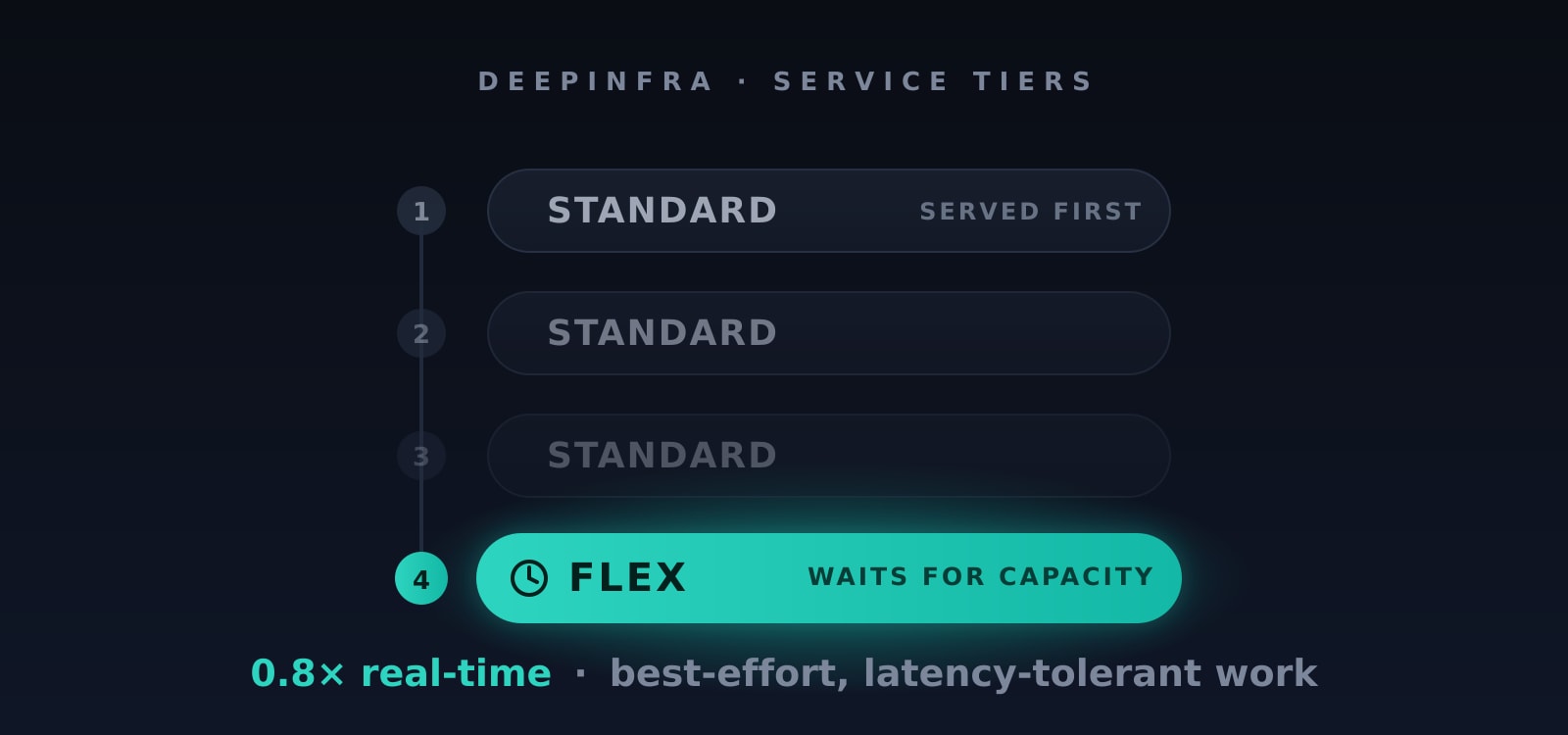 Introducing the Flex Service Tier: Cheaper Inference When You Can WaitRun latency-tolerant work at 0.8× real-time — best-effort, sheddable, same OpenAI-compatible API.
 Reliable JSON-Only Responses with DeepInfra LLMs<p>When large language models are used inside real applications, their role changes fundamentally. Instead of chatting with users, they become infrastructure components: extracting information, transforming text, driving workflows, or powering APIs. In these scenarios, natural language is no longer the desired output. What applications need is structured data — and very often, that structure is […]</p>
 AI Model Distillation: Teacher vs. Student Models<p>Your ticket classifier runs on a 1.6 trillion parameter model. It reads a support message, decides whether it is a billing question or a bug report, and returns one word. You’re paying frontier prices for a job a model a hundredth the size could finish in half the time. AI model distillation is the standard […]</p>




© 2026 DeepInfra. All rights reserved.