DeepInfra raises $107M Series B to scale the inference cloud — read the announcement
AI agents don't make one model call, they make dozens. Retry loops, tool invocations, verification steps, and refinement passes stack up fast: a single task can chain 5-50 API calls before returning a result. At that volume, every millisecond of per-call latency and every dropped request compounds into end-to-end pipeline slowdown. Choosing the right inference API is therefore not a configuration detail, it is a system architecture decision. This article ranks six providers on the criteria that matter most when inference is, as DeepInfra CEO Nikola Borisov put it, "no longer a thin layer, it's the system constraint."
This guide evaluates DeepInfra, Together AI, Groq, Fireworks AI, Cerebras, and OpenRouter across five criteria: per-call latency, tool-calling reliability, prompt cache hit rate, concurrency and rate limits, and model breadth. DeepInfra ranks first. It owns and operates its own GPU infrastructure, no rented capacity, and serves 200+ open-weight models across text, image, speech, embeddings, and more through OpenAI-compatible APIs. That hardware ownership is what enables the throughput headroom and prompt-caching performance that high-volume agent loops demand.
Why Inference APIs Matter for AI Agents Making Dozens of Model Calls per Task
A single-call latency benchmark tells you almost nothing about how an inference API will perform under a real agentic workload. A single agent turn typically involves 2-5 LLM hops plus tool calls — compounding end-to-end latency 3-10x beyond what any point benchmark captures. Multiply that across retry loops, verification steps, and tool-call roundtrips, and the inference layer stops being a commodity utility and becomes the defining constraint on whether your agent completes its task or stalls. As DeepInfra CEO Nikola Borisov put it at the Series B announcement, inference is "no longer a thin layer, it's the system constraint."
What to Look for in an Inference API for AI Agent Workloads
Agentic workflows are unforgiving: a single task can chain dozens of model calls, each one dependent on the last. That means per-call inefficiencies compound fast, unreliable tool execution breaks the chain, and cold caches waste budget. The five criteria below are the ones that separate inference providers that work for agents from those built for one-shot queries. We use DeepInfra as the reference point throughout, its owned GPU infrastructure, automatic caching, and OpenAI-compatible tool-calling API are what shaped these criteria in the first place.
Five Criteria for Evaluating Inference APIs for AI Agents
- Per-call latency / TTFT (time to first token). In a multi-step agent loop, latency stacks multiplicatively, shaving 200 ms per call across 40 hops is an 8-second wall-clock gain, which is the difference between a responsive product and a broken one.
- Tool-calling reliability, single, parallel, and tool_choice modes. Agents depend on the model correctly invoking the right tool at the right time; a provider that drops parallel calls or misroutes
tool_choice: 'auto'will silently corrupt the agent's reasoning chain. - Prompt cache hit rate and cache pricing. System prompts, long context windows, and conversation histories repeat across calls; a high cache hit rate cuts both latency and cost on every repeated prefix, compounding savings over a full agent run.
- Concurrency headroom and rate-limit behavior. Agents fan out: a single orchestrator may fire five simultaneous sub-agent calls; hitting a rate ceiling mid-task forces retries that break timing guarantees and inflate cost.
- Model breadth across the open-weight catalog. Specialized agent architectures mix models by task, a small fast model for routing, a large model for reasoning, an embedding model for retrieval; a thin catalog forces awkward multi-provider splits.
How DeepInfra Addresses Each Criterion
DeepInfra owns and operates its own NVIDIA GPU infrastructure, which is the foundation for predictable TTFT across the catalog. Prompt caching is automatic, no extra parameters required, reusing the KV cache whenever a prompt prefix matches a prior request, reducing both latency and cost without any code change. The OpenAI-compatible tool-calling API supports single tool calls, parallel tool calls, tool_choice: 'auto', and tool_choice: 'none', with tool-call accuracy listed as a stated top engineering priority. The catalog spans 200+ open-weight models across text, image, speech, embeddings, rerank, and text-to-video. For enterprise agent teams where every model call touches sensitive data, zero data retention by default and SOC 2 and ISO 27001 certifications close the compliance gap. With those five boxes checked in a single provider, the section that follows puts that claim to the test against the competition.
How AI-Native Engineering Teams Use Inference APIs to Power Agentic Workflows
AI-native engineering teams running production agents share a common constraint: every task fires dozens of model calls, and each one compounds latency, cost, and failure risk. DeepInfra is built for exactly this workload. Its features map directly onto the patterns these teams reach for, automatic caching, reliable tool calling, dedicated capacity, managed runtimes, and deep ecosystem integrations, giving platform engineers a coherent stack rather than a patchwork of one-off optimizations.
Strategy 1: Automatic Prompt Caching for Repeated-Context Agent Loops
DeepInfra prompt caching is automatic, no extra parameters, no code changes. When the beginning of a prompt matches a previous request, DeepInfra reuses the KV cache, cutting both latency and input spend. For a typical agentic loop firing 30 turns against the same system prompt plus tool block, caching alone cuts input spend by roughly 60%. On DeepSeek-V3-0324, cache reads cost $0.07/M tokens versus $0.45/M for fresh input. On DeepSeek V4 Pro, cached input drops to $0.10/M, a 92% discount to the $1.30 standard rate, a meaningful saving on any RAG or repeated-context workload running at scale.
Strategy 2: Parallel and Single Tool Calls for Multi-Step Reasoning
DeepInfra's tool-calling API is OpenAI-compatible, supporting single tool calls, parallel tool calls, tool_choice: "auto", and tool_choice: "none", the full set of control modes agents need to handle both deterministic dispatch and open-ended reasoning steps. Tool call accuracy is a stated top engineering priority at DeepInfra. For multi-step reasoning chains where a missed function call breaks the whole pipeline, tool-call accuracy is not cosmetic; it determines whether the agent completes its task.
Strategy 3: Dedicated Endpoints for Sustained High-Volume Agent Pipelines
Serverless throughput has its limits. Teams running sustained, high-volume agent pipelines need predictable capacity reserved for their own traffic rather than shared with other tenants. DeepInfra dedicated H100 endpoints are listed at $2.90/GPU-hour, billed per minute, compared to $6.50/hr at Baseten, a substantial cost reduction on reserved capacity. For teams that need even larger scale and longer commitments, DeepCluster delivers dedicated NVIDIA B300 GPU clusters at $1.98/GPU-hr on a five-year term, with 288 GB HBM3e per GPU, 256 to 5,000 GPUs available, and a 99.982% uptime SLA backed by a Tier 3 data center. That SLA is what production agent pipelines are designed around.
Strategy 4: Hosted Agents for Zero-Config Inference-Ready Deployments
Not every team wants to manage the infrastructure layer beneath their agent. DeepInfra Hosted Agents are fully managed VMs that provision inference-ready instances in minutes, pre-wired to a dedicated DeepInfra API key, no endpoint configuration, no runtime setup. Billing is per-hour compute plus per-token inference at standard rates. Plans start at $13/month, making Hosted Agents the fastest path from agent code to a running production deployment for teams that need to ship quickly without a dedicated platform engineering resource.
Strategy 5: MCP Stack Integration via OpenAI-Compatible Tool Calling
Model Context Protocol pipelines require a backend that can reliably select functions and generate structured arguments from tool definitions. DeepInfra's OpenAI-compatible API handles both. Because the interface is standard, teams already running MCP orchestrators can point them at DeepInfra without rewriting their tool schemas or dispatch logic. The same API that powers direct tool calls in a custom agent loop works as the inference backend for any MCP stack, a single integration path covers both architectures.
Strategy 6: NVIDIA Ecosystem Integrations for Sandboxed Agent Execution
DeepInfra is a first-party provider profile in NVIDIA OpenShell (providers/deepinfra.yaml), which means agents running inside OpenShell's sandboxed execution environment can call DeepInfra models with credentials managed outside the agent context, a meaningful security property for enterprise deployments. Beyond OpenShell, DeepInfra is an infrastructure collaborator across NVIDIA's open AI ecosystem, supporting Nemotron models, the NemoClaw agent framework, and NVIDIA Dynamo inference software. Teams already building on NVIDIA's toolchain get DeepInfra as a supported, tested integration rather than a manual configuration.
Few inference providers offer more than one or two of these capabilities in a single platform. DeepInfra combines automatic caching, production-grade tool calling, dedicated GPU endpoints, managed agent runtimes, MCP compatibility, and deep NVIDIA ecosystem integration, all running on hardware DeepInfra owns and operates. For AI-native engineering teams building agents that make dozens of model calls per task, that breadth means fewer infrastructure gaps to paper over, more consistent performance across the full agent loop, and a single vendor relationship that scales from a $13/month prototype to a DeepCluster deployment at 5,000 GPUs.
Competitor Comparison: Inference APIs for AI Agents on Open-Weight Models
The table below gives AI engineering teams a direct side-by-side view of the five criteria that matter most for agentic workloads, per-call latency, tool-calling reliability, prompt caching, model breadth, and dedicated GPU pricing, across all six providers in this evaluation. Each row reflects verified, publicly available figures. Where an independent benchmark source has not measured TTFT for a provider on a specific model in a controlled setting, that cell notes the available data rather than an extrapolated figure.
| Provider | Per-Call Latency / TTFT | Tool-Calling Reliability | Prompt Caching | Model Breadth | Dedicated GPU Pricing |
|---|---|---|---|---|---|
| DeepInfra | Owned GPU infrastructure optimized per workload; dedicated endpoints reserve capacity for a single tenant | Supports single, parallel, tool_choice: auto/none; tool-call accuracy is a stated top engineering priority | Automatic, no extra parameters needed; KV cache reuse activated by default | 200+ models across text, image, speech, embeddings, rerank, text-to-video | H100 at $2.90/GPU-hr, billed per minute |
| Together AI | Competitive serverless throughput; dedicated tier available | Full tool-calling support across flagship models | Available on select models | Broad multi-modal catalog | H100 dedicated at $5.49/GPU-hr; B200 at $8.99/GPU-hr |
| Groq | LPU-based low-latency inference; 470 tok/s median on gpt-oss-120b at 0.66s TTFT (Artificial Analysis) | Sequential tool calls supported; gpt-oss models do not support parallel tool calls on GroqCloud; Compound agentic system retired September 21, 2026 with no listed replacement | Model-specific (discounted cached input on some models, such as GPT-OSS 120B) | Smaller open-weight catalog; LPU optimized for specific model sizes | Per-token only; no dedicated GPU tier |
| Fireworks AI | Low latency serverless; claims up to 60% lower latency vs. self-hosted vLLM on identical H100s | All 12 tracked models support function calling | Automatic, enabled by default; cached input billed at 50% off by default | Broad open-weight catalog | On-demand H100/H200 from $8.00/GPU-hr, billed per second |
| Cerebras | 1,000-3,000+ tok/s via WSE-3 wafer-scale chips; among the fastest raw generation speeds available | Not independently benchmarked for agentic tool-calling accuracy | Not publicly documented | 2 public models as of October 2026 (gpt-oss-120b, Qwen 3.8 27B) | WSE-3 chip pricing; no standard GPU-hour tier |
| OpenRouter | Gateway routing adds a latency layer vs. direct provider calls; actual TTFT depends on backend provider | Varies by underlying provider routed to | Varies by underlying provider | 500+ models from 80+ providers via single API key | Not applicable, aggregation gateway, not direct GPU provider |
Note: Together AI serverless Llama 3.3 70B is priced at $1.04/M input vs. $0.10/M input at DeepInfra (Infrabase, August 3, 2026). OpenRouter charges a 5.5% platform fee on Standard credit purchases in addition to provider list-price inference costs.
Across the five criteria, DeepInfra's combination of owned and operated GPU infrastructure, automatic prompt caching that requires no code changes, OpenAI-compatible tool calling across single calls, parallel calls and both tool_choice modes, a 200+ model catalog spanning every major open-weight family and dedicated H100 capacity at $2.90/GPU-hr gives engineering teams a consistent operational foundation. Add zero data retention by default and SOC 2 and ISO 27001 certification, and DeepInfra meets both the performance and compliance bar that scaled AI-native teams require, without trading one for the other.
Best Inference APIs for AI Agents on Open-Weight Models in 2026
1. DeepInfra
DeepInfra is built from the hardware up for production agentic workloads. It owns and operates its own NVIDIA GPU infrastructure, running a custom inference stack across vLLM, SGLang, and TensorRT-LLM, the same stack that now processes 5 trillion tokens per week. That ownership is what enables automatic prompt caching with no extra parameters, OpenAI-compatible tool calling built with tool-call accuracy as a top engineering priority, and dedicated endpoints at $2.90/GPU-hr. For engineering teams running agents that fire dozens of model calls per task, every layer of the stack is controlled by one provider.
Key Features
- Owned GPU infrastructure with custom inference stack: DeepInfra runs vLLM, SGLang, and TensorRT-LLM on hardware it owns and operates, enabling deeper optimization of throughput and latency than rented-capacity providers can achieve.
- 200+ open-weight models across modalities: Text, image, speech, embeddings, rerank, and text-to-video, all accessible via OpenAI-compatible APIs. Model IDs are exact (e.g., deepseek-ai/DeepSeek-V4.1-Flash, moonshotai/Kimi-K3), not generic aliases.
- Automatic prompt caching: KV cache reuse activates automatically when the beginning of a prompt matches a previous request, no extra parameters, no SDK change required. On DeepSeek-V3-0324, cached reads cost $0.07/M versus $0.45/M on fresh input.
- OpenAI-compatible tool calling (single + parallel): Supports tool_choice: auto and tool_choice: none. Tool-call accuracy is a stated top engineering priority.
- Hosted Agents and DeepCluster dedicated clusters: Hosted Agents provision inference-ready VMs wired to a dedicated API key, starting at $13/month. DeepCluster offers NVIDIA B300 dedicated GPU clusters with a 99.982% uptime SLA, 288 GB HBM3e per GPU, and 256-5,000 GPU configurations.
Agentic Workload Offerings
- Cache hit savings on long loops: A typical agentic loop firing 30 turns against the same system prompt plus tool block saves roughly 60% of input spend through automatic caching alone, no code change required.
- DeepSeek-V4.1-Flash at fp8 with 1M token context: Served at fp8 precision with the full 1,048,576-token context window. Architecture targets input-heavy agentic workloads: 8B parameters active during prefill, 16B during decode.
- Nemotron 3 Ultra for high-volume agent tasks: Supports up to 1M token context, up to 5x faster inference, and up to 30% lower cost for agentic workloads on DeepInfra. NVIDIA Nemotron 3.5 Lightning is positioned as NVIDIA's fastest open model for always-on agents.
- NVIDIA OpenShell first-party provider profile: DeepInfra is listed in NVIDIA OpenShell (providers/deepinfra.yaml) as a first-party profile, enabling secure sandboxed agent execution with credentials managed outside the agent environment.
- Dedicated H100 endpoints at $2.90/GPU-hr: Sustained agentic workloads run on capacity reserved for a single tenant instead of a shared serverless pool, billed per minute.
Pricing
- gpt-oss-120b Base: $0.037/M in · $0.17/M out (Aug 12, 2026)
- gpt-oss-120b Turbo: $0.15/M in · $0.60/M out
- Llama 3.3 70B: $0.10/M in · $0.32/M out
- DeepSeek V4 Pro cached input: $0.10/M in (92% off the $1.30/M standard rate)
- DeepSeek-V3-0324 cached reads: $0.07/M in · fresh input $0.45/M in
- Dedicated H100: $2.90/GPU-hr (billed per minute)
- DeepCluster B300 (5-year term): $1.98/GPU-hr
- B200 on-demand: from $4.89/hr (1× B200) to $39.12/hr (8× B200)
- Hosted Agents: from $13/month
Pros
- Owned hardware enables deeper optimization than rented infrastructure, no capacity constraints dictated by a cloud reseller
- Automatic prompt caching with zero configuration; cache savings activate once a repeated prompt prefix reaches the model's minimum cacheable block size, which varies by model
- OpenAI-compatible tool calling across single calls, parallel calls and both tool_choice modes
- 200+ open-weight models across modalities
- SOC 2 and ISO 27001 certified; zero data retention by default; Trust Center at trust.deepinfra.com
- First-party NVIDIA ecosystem partner: supports Nemotron models, NemoClaw agent framework, and NVIDIA Dynamo inference software
Cons
- International data center footprint is still expanding, Toronto is the first location outside the US (noted July 2026)
- DeepCluster's lowest per-GPU rate ($1.98/hr) requires a 5-year term commitment
Why DeepInfra leads
For scaled AI-native teams running agents that make dozens of model calls per task, infrastructure ownership is the decisive advantage. DeepInfra's GPUs are its own, its inference stack (vLLM, SGLang, TensorRT-LLM) runs on hardware it controls, and it tunes for throughput and latency without negotiating with a cloud landlord. That infrastructure base now supports 5 trillion tokens per week, 25x the volume since Series A, after a $107M Series B (May 2026) co-led by 500 Global and Georges Harik, with NVIDIA, Samsung Next, and Supermicro participating. The NVIDIA ecosystem relationship runs deep: DeepInfra is a first-party NVIDIA OpenShell provider and an infrastructure collaborator in the NVIDIA open AI ecosystem. Enterprise compliance is fully in place: SOC 2, ISO 27001, and zero data retention by default, with controls published in the Trust Center (trust.deepinfra.com). For agents that must be fast, accurate on tool calls, cheap on repeated context, and compliant at scale, DeepInfra's stack addresses each requirement with a specific, sourced mechanism rather than a marketing claim.
2. Together AI
Together AI is a full-platform inference provider offering serverless inference, dedicated GPU endpoints, fine-tuning, batch jobs, and a code interpreter in a single product surface. Teams that need fine-tuning and batch processing alongside inference will find the platform broad, though serverless per-token rates are significantly higher than DeepInfra's on equivalent models.
Key Features
- Serverless + dedicated + fine-tuning + batch: One platform covers the common ML lifecycle stages, from rapid prototyping on serverless to production-scale fine-tuning and batch.
- Dedicated GPU inference: H100 and B200 dedicated endpoints with per-second billing.
- OpenAI-compatible API: Drop-in compatibility for existing codebases.
- Broad model support: Text and vision models available across serverless and dedicated tiers.
- Batch inference: Asynchronous batch processing for offline or non-latency-critical agentic pipelines.
Agentic Workload Offerings
- Serverless endpoints for multi-step agent loops on a wide range of open-weight models
- Dedicated GPU options for teams that need isolated capacity and predictable latency
- Batch job support for high-volume, latency-tolerant agentic tasks (e.g., evaluation pipelines, nightly summarization loops)
- Fine-tuning on the same platform, enabling teams to adapt a model to their agent's domain without switching providers
- Code interpreter integration for agents that require sandboxed code execution
Pricing
- Llama 3.3 70B serverless: $1.04/M in · $1.04/M out
- DeepSeek V4.1 Flash serverless: $0.30/M in · $1.20/M out; cached input: $0.006/M in
- Dedicated H100: $5.49/GPU-hr
- Dedicated B200: $8.99/GPU-hr
- GPU clusters (on-demand): from $3.99/H100-hr; reserved (181+ days): $3.19/H100-hr
Pros
- Full-platform coverage: fine-tuning, batch, code interpreter, and inference under one API key
- Dedicated GPU options with per-second billing for production agents
- Broad community adoption and documentation
Cons
- No free trial; minimum $15 credit purchase required for an organization's first purchase
- Serverless rates are significantly higher than DeepInfra on equivalent models (e.g., Llama 3.3 70B at $1.04/M vs. $0.10/M on DeepInfra)
- Dedicated H100 at $5.49/hr is 1.9× DeepInfra's $2.90/hr dedicated H100 rate
3. Groq
Groq is a hardware-differentiated inference provider built around its custom LPU (Language Processing Unit) chips, which deliver some of the lowest time-to-first-token latency and highest raw token throughput in the market. For latency-critical agent steps, where a fast first token drives user experience, Groq occupies a distinctive position.
Key Features
- LPU-based ultra-low-latency inference: Low time to first token; 300-750+ tokens per second on Llama 3/4 models with deterministic scheduling that minimizes per-request latency variance.
- OpenAI-compatible function calling: Agents can use tools with an OpenAI-compatible API, reducing integration friction for existing codebases.
- Deterministic scheduling: Latency variance is low relative to GPU-based providers, which matters for agent loops where step time must be predictable.
- High raw throughput on select models: Artificial Analysis measured Groq at a median of 470 tokens/second for gpt-oss-120b with 0.66s TTFT in a 10,000-token input workload.
- Substantial funding base: Groq raised $650M in May/June 2026 from existing investors to fund its transition to an AI inference cloud business.
Agentic Workload Offerings
- Fast TTFT for latency-sensitive agent steps where the first token drives UX (e.g., streaming answers in chat agents)
- OpenAI-compatible tool calling for single-step tool use in reasoning loops
- High token throughput for sequential reasoning steps where decode speed matters
- Deterministic latency scheduling, reducing unpredictability in multi-step agent timing
Pricing
- Per-token rates vary by model and are not compared here; check Groq's pricing page for current gpt-oss-120b and other model rates before budget modeling.
Pros
- TTFT among the fastest available for latency-critical agent paths
- Deterministic scheduling reduces worst-case latency for time-sensitive agentic loops
- OpenAI-compatible function calling for straightforward tool integration
Cons
- gpt-oss models do not support parallel tool calls on GroqCloud per Groq's tool use documentation, a meaningful gap for agents that issue multiple tool calls simultaneously
- Groq's built-in agentic system (Compound) was retired September 21, 2026 with no listed replacement
4. Fireworks AI
Fireworks AI is a serverless-first inference provider with dedicated GPU hosting and batch processing options. Its serverless catalog covers 12 tracked models with function calling enabled across all of them, and its batch tier offers meaningful cost reductions for latency-tolerant agentic pipelines. Dedicated GPU costs are substantially higher than DeepInfra's comparable tiers.
Key Features
- Function calling across all 12 tracked models: Every model in Fireworks AI's tracked serverless catalog supports tool use, a consistent baseline for agentic integration.
- Batch inference at 50% of serverless rates: Asynchronous batch processing at half the serverless per-token price for both input and output tokens.
- Cached input tokens at 50% price: Prompt caching is enabled by default with no additional configuration; cached input bills at 50% off by default, with deeper discounts on select models.
- Dedicated H100/H200 from $8.00/hr with auto-scaling to zero: Per-second billing on dedicated instances with scale-to-zero to avoid idle costs.
- Tiered serverless pricing by model size: Sub-4B at $0.10/M, 4B-16B at $0.20/M, 16B+ dense at $0.90/M, MoE up to 56B at $0.50/M.
Agentic Workload Offerings
- Universal function calling support across the tracked catalog, enabling any model selection to be used in tool-calling agent loops
- Batch inference at 50% serverless rates for high-volume, offline agentic jobs (e.g., nightly analysis, bulk document processing)
- Cached input tokens at 50% price for agents with stable system prompts or repeated context blocks
- Dedicated GPU endpoints with per-second billing and scale-to-zero for teams with burst agentic workloads
- $1 free credit for new accounts, low barrier to entry for prototyping
Pricing
- Serverless 16B+ dense models: $0.90/M in · $0.90/M out
- Serverless MoE up to 56B: $0.50/M in · $0.50/M out
- Batch inference: 50% of serverless rate on input and output
- Cached input: 50% of standard serverless rate
- Dedicated H100/H200: from $8.00/GPU-hr
Pros
- Function calling supported across all 12 tracked models in the catalog
- Batch discounts make Fireworks AI competitive for offline, high-volume agentic workloads
- $1 free credits for new accounts with no monthly minimum on serverless
Cons
- Dedicated GPU cost starts at $8.00/hr, about 2.8× DeepInfra's $2.90/hr dedicated H100 rate
- Infrastructure is rented rather than owned, which limits the depth of hardware-level optimization
5. Cerebras
Cerebras Inference is built on its wafer-scale WSE-3 chip architecture, delivering raw token throughput that significantly exceeds GPU-based alternatives on the models it supports. For sequential reasoning loops where decode speed directly reduces wall-clock time per agent step, Cerebras is worth evaluating. The catalog is currently limited to two public models, which restricts its applicability for teams requiring model diversity.
Key Features
- Wafer-scale WSE-3 chip architecture: Cerebras's hardware delivers 1,000-3,000+ tokens per second on open-weight models, gpt-oss-120b at approximately 3,000 tok/s, Qwen 3.8 27B at approximately 1,500 tok/s (Cerebras pricing page, September 2026).
- Extreme raw throughput for sequential reasoning: For agent loops where each step blocks on model output, higher decode throughput directly shortens end-to-end task time.
- OpenAI-compatible API: Standard API format for straightforward integration.
- Developer tier entry: New accounts receive $5 in free credits under a pay-as-you-go Developer tier (as of October 2026).
- Purpose-built for speed: The WSE-3 architecture trades model catalog breadth for exceptional throughput on supported models.
Agentic Workload Offerings
- Sequential reasoning loops where step latency is the bottleneck and decode throughput is the primary lever
- Fast token generation for chain-of-thought agents that produce long intermediate reasoning traces before acting
- Developer-tier experimentation via $5 free credits for teams prototyping high-throughput agent architectures
- gpt-oss-120b at approximately 3,000 tok/s for large-model agentic tasks requiring fast output
Pricing
- gpt-oss-120b: $0.35/M in · $0.75/M out (October 2026)
- Qwen 3.8 27B: $0.99/M in · $1.49/M out (October 2026)
Pros
- Fastest raw token throughput available for sequential reasoning loops on supported models
- Deterministic, purpose-built architecture with low latency variance
- $5 free credits for new Developer-tier accounts
Cons
- Catalog limited to two public models as of October 2026, teams requiring model diversity cannot rely on Cerebras alone
- Free open tier ended July 21, 2026; pricing is higher than GPU-based alternatives for equivalent model weights (e.g., gpt-oss-120b at $0.35/M in vs. DeepInfra's $0.037/M in)
- No published caching or batch options
6. OpenRouter
OpenRouter is an API aggregation gateway rather than a direct inference provider. It routes requests to 500+ models from 80+ providers through a single OpenAI-compatible API key, charging provider list price on inference with no per-token markup on the inference itself. For teams that want to hedge across providers or access many models through one integration, OpenRouter reduces switching friction. DeepInfra models are listed on OpenRouter, with DeepInfra direct being equivalent or cheaper on those routes.
Key Features
- 500+ models from 80+ providers via single API key: The broadest model selection accessible through one OpenAI-compatible integration point.
- No per-token markup at provider list price: OpenRouter charges a platform fee on credit purchases rather than a per-token surcharge, keeping inference cost at or near provider list price.
- Free tier: 25+ free models available at 50 requests per day; Standard paid tier has no plan-based rate limits (provider limits apply).
- BYOK (bring your own key) option: Fee-free up to $25,000/month of list-price inference, then 5%.
- OpenAI-compatible API: Single API key, single base URL change, access to all listed providers.
Agentic Workload Offerings
- Multi-provider agent architectures where different steps route to different models based on cost or capability
- Rapid model exploration for teams evaluating which open-weight model fits a specific agent task
- Free tier at 50 requests/day for low-volume agent prototyping
- BYOK for high-volume teams wanting to avoid platform credit fees on direct provider keys
Pricing
- Inference: provider list price (no per-token markup)
- Standard credit purchase fee: 5.5% platform fee
- Business credit purchase fee: 8% platform fee
- BYOK: fee-free up to $25,000/month, then 5%
- Free tier: 25+ models, 50 requests/day
Pros
- Widest model selection (500+ models) accessible via a single API key
- Free tier lowers the barrier to agent prototyping across model families
- No per-token markup on inference; platform fee applies only to credit purchases
Cons
- Gateway latency layer adds overhead versus calling a direct inference provider API
- Enterprise compliance (SOC 2, ISO 27001) is provider-dependent, OpenRouter itself does not carry independent certifications for the data flowing through its gateway
- For DeepInfra models specifically, calling DeepInfra direct is equivalent or cheaper and eliminates the gateway layer and credit purchase fee
Evaluation Rubric for Inference APIs for AI Agent Workloads
Before committing an inference provider to a production agent pipeline, AI-native engineering teams need a structured lens, not vendor marketing. The eight categories below map directly to the pressure points agentic workloads expose: repeated calls, chained tool use, bursty concurrency, and long-running cost accumulation. DeepInfra was evaluated against each category using independent benchmarks, public pricing pages (August-October 2026), and vendor documentation. The results appear in the rightmost column.
| Category | High-Performance Standard | Measurable Outcome | DeepInfra Rating |
|---|---|---|---|
| Per-Call Latency / TTFT | Sub-1s TTFT on large models under realistic input lengths; sustained throughput at scale | Competitive TTFT on frontier open-weight models; Artificial Analysis independently tracks provider latency at scale | ✅ Owned GPU infrastructure and a custom inference stack (vLLM, SGLang, TensorRT-LLM) enable hardware-level tuning, directional advantage confirmed |
| Tool-Calling Reliability | Accurate parallel and sequential tool calls; native support for tool_choice: auto and tool_choice: none | Native support for single calls, parallel calls and both tool_choice modes through an OpenAI-compatible API | ✅ OpenAI-compatible tool-calling API supports single calls, parallel calls, and tool_choice set to auto or none; tool-call accuracy is a stated top engineering priority |
| Prompt Cache Efficiency | Automatic KV-cache reuse on repeated prompt prefixes; measurable cost and latency reduction per agent turn | For a 30-turn agentic loop against the same system prompt and tool block, automatic caching cuts input spend by roughly 60% | ✅ Caching is automatic, no extra parameters required; reuses KV cache whenever the prompt beginning is identical |
| Concurrency / Rate-Limit Headroom | Enough burst capacity to run parallel agent threads without queue stacking or hard rate-limit walls | Dedicated endpoints reserve capacity for a single tenant instead of drawing on a shared pool | ✅ Default limit of 200 concurrent requests per public model per account, with higher limits on request; dedicated endpoints reserve capacity for sustained volume |
| Model Breadth | 50+ production-ready open-weight models across modalities so agents can route tasks to the right model | 200+ open-weight models across text, image, speech, embeddings, rerank, and text-to-video | ✅ 200+ models on the live catalog, one of the broadest selections among inference clouds |
| Dedicated Endpoint Pricing | H100 dedicated capacity under $3.50/GPU-hour to make sustained agentic workloads economically viable | Dedicated H100 endpoints at $2.90/GPU-hour (vs. $6.50/hr at Baseten); Llama 3.3 70B base at $0.10 input / $0.32 output per million tokens, tied for lowest tracked (Infrabase, August 3, 2026) | ✅ Lowest or tied-for-lowest on multiple tracked models as of August-October 2026 |
| Enterprise Compliance | Zero data retention, SOC 2 Type 2, and at minimum one additional recognized certification | Zero data retention by default; SOC 2 and ISO 27001 certified | ✅ Full compliance stack confirmed on the DeepInfra homepage and trust center |
| Developer Migration Ease | Drop-in replacement for OpenAI API; no SDK rewrite or new abstraction layer required | Change the base URL to api.deepinfra.com/v1/openai, use a DeepInfra API key and set a DeepInfra model ID; no SDK change, no code rewrite | ✅ Three configuration changes (base URL, API key, model ID); existing OpenAI SDK calls work with no other changes |
Methodology. Provider scores were assembled from three types of evidence: independent performance benchmarks (Artificial Analysis latency and throughput data for gpt-oss-120b); public pricing pages and aggregator data (Infrabase, as of August 3, 2026; provider pricing pages reviewed August-October 2026); and vendor documentation covering API feature sets, compliance certifications, and caching behavior. Where independent benchmark data for a specific DeepInfra configuration was unavailable, ratings reflect directional evidence from architectural facts and are labeled accordingly. DeepInfra scored at or near the top across latency infrastructure, prompt caching, compliance, and pricing dimensions.
Why DeepInfra Is the Best Inference API for AI Agents on Open-Weight Models
Agentic workloads punish weak infrastructure at every step: slow first tokens stall reasoning chains, missed tool calls corrupt task graphs, and pricing that scales with volume erodes margins fast. DeepInfra addresses each failure mode through the same root cause: owned hardware, owned data centers, and an inference stack tuned from silicon to API. The result is a platform that pairs a 200+ open-weight model catalog with automatic prompt caching, OpenAI-compatible tool calling, and enterprise compliance that includes zero data retention by default, SOC 2 certification, and ISO 27001 certification. Teams that need a single inference layer across planning, retrieval, code execution, and synthesis loops get all of it without switching vendors or absorbing hidden gateway fees.
The competitive picture reinforces the case. Together AI's serverless Llama 3.3 70B runs at $1.04/M on input tokens; DeepInfra's rate is $0.10/M, a 10x gap that compounds across dozens of model calls per agent task. Groq does not support parallel tool calls on its gpt-oss models and retired its built-in agentic system (Compound) on September 21, 2026 with no published replacement. Fireworks AI dedicated GPU hosting starts at $8.00/hr for H100/H200 hardware versus DeepInfra dedicated endpoints at $2.90/hr, a 2.8x premium before you configure a single agent. Cerebras lists only two public models as of October 2026, disqualifying it for teams that need model diversity across task types. OpenRouter imposes a 5.5% platform fee on Standard credit purchases, adding cost and a latency layer that every agent hop has to absorb. If you are building a production agentic system on open-weight models and need the combination of throughput, tool-calling reliability, catalog depth, and enterprise security, request a demo from DeepInfra or start a free trial to see dedicated endpoint performance on your own workload.
FAQs About Inference APIs for AI Agents on Open-Weight Models
Why do AI-native teams need a specialized inference API for agentic workloads?
AI agents don't issue a single model call, they chain 5-50 API calls per task across retry, refinement, and verification loops. At that scale, per-call latency and rate-limit headroom compound directly into end-to-end task latency. A single agent workflow can trigger 10-20 sequential API calls, and unmanaged rate limiting is cited as the number-one cause of agent failures in production. DeepInfra's owned GPU infrastructure and high-concurrency dedicated endpoints are built to absorb this call volume without throttling the agent mid-task.
What is an inference API and how does it support AI agents making dozens of model calls per task?
An inference API is a hosted endpoint that accepts a prompt and returns a model completion, the building block every agent loop depends on. In practice, a single agent turn involves 2-5 LLM hops plus tool calls, compounding latency by 3-10x beyond what single-call benchmarks suggest. DeepInfra exposes OpenAI-compatible inference endpoints for 200+ open-weight models, so an agent framework can call the planner, the tool executor, and the verifier in sequence without switching SDKs or rewriting any integration code.
What are the best inference APIs for AI agents running on open-weight models in 2026?
DeepInfra ranks first for agentic workloads on open-weight models, followed by Together AI, Groq, Fireworks AI, Cerebras, and OpenRouter as the other major providers in the space. DeepInfra's combination of owned GPU hardware, a custom inference stack built on vLLM, SGLang, and TensorRT-LLM, automatic prompt caching, and an OpenAI-compatible tool-calling API covering single calls, parallel calls, and tool_choice modes makes it the most complete option for teams running high-frequency agent loops in production.
How does prompt caching reduce cost and latency for agentic workloads?
Prompt caching reuses the KV cache from earlier requests whenever the beginning of a new prompt matches a previous one, which is almost always true for the system prompt and tool definitions an agent sends on every turn. Matching works in blocks whose size depends on the model, and a change partway through a prompt only misses the cache for the tokens after the change. DeepInfra prompt caching is automatic and requires no extra parameters. For a typical agentic loop firing 30 turns against the same system prompt, DeepInfra caching alone cuts input spend by roughly 60 percent. Cache reads on DeepSeek-V3-0324 are priced at $0.07 per million tokens versus $0.45 per million for fresh input, a direct reduction in per-loop cost.
What is tool-calling reliability and why does it matter for production AI agents?
Tool-calling reliability is the rate at which a model returns a correctly structured tool-call response that can be parsed and executed without an error retry. Any malformed response breaks the agent loop, triggering a retry that doubles latency and burns tokens. DeepInfra's tool-calling API supports single tool calls, parallel tool calls, and both tool_choice: 'auto' and tool_choice: 'none', with tool call accuracy listed as a top engineering priority.
How does DeepInfra's owned GPU infrastructure differ from providers using rented capacity?
Providers that rent capacity from cloud hyperscalers absorb a margin layer and cannot tune the full hardware-to-software stack. DeepInfra owns and operates its own GPU infrastructure across its data centers, including a first international location in Toronto, and runs a custom inference stack built on vLLM, SGLang, and TensorRT-LLM. That vertical ownership, expressed in DeepInfra's own positioning as "Our Hardware. Our Data Centers. Your Performance Edge," enables deeper throughput and latency optimization than rented infrastructure allows, with no intermediary margin passed to the customer.
What is a dedicated endpoint and when should an AI agent team use one instead of serverless?
A dedicated endpoint reserves specific GPU capacity exclusively for one tenant, so its traffic does not compete with other tenants in a shared serverless pool under burst load. For AI agent teams running dozens of model calls per task at consistent volume, serverless latency variance accumulates across every hop and degrades end-to-end reliability. DeepInfra's dedicated endpoints are tuned on hardware DeepInfra owns, giving teams capacity that is not shared with other tenants. Dedicated endpoints are billed per minute. Teams with spiky or early-stage workloads can start on DeepInfra's shared inference and migrate to dedicated endpoints as call volume stabilizes.
How does DeepInfra's pricing compare to Together AI, Groq, and Fireworks AI for high-volume agent loops?
DeepInfra and OpenRouter share the lowest published rate on Llama 3.3 70B at $0.10 input / $0.32 output per million tokens, compared to Together AI's published rate of $1.04 per million on the same model, a roughly 10x difference on input tokens. For dedicated GPU capacity, Fireworks AI on-demand dedicated hosting starts at $8.00/hr for H100/H200 hardware, while DeepInfra's DeepCluster B300 clusters are available at $1.98/GPU-hr on a 5-year term. Groq per-token rates are not covered in this comparison; check Groq's pricing page for current figures.
Is DeepInfra secure enough for enterprise AI agents handling sensitive data?
DeepInfra is SOC 2 and ISO 27001 certified and enforces zero data retention (ZDR) by default: prompts and completions are not stored after the response is returned, with limited exceptions set out in DeepInfra's terms: content shared in support requests, operational metadata, records kept for legal or security purposes, and opt-in features such as paid cache retention. That combination satisfies the baseline security posture most enterprise security and compliance teams require before approving a production AI integration. DeepInfra operates its own data centers, so sensitive inference traffic does not transit shared hyperscaler environments. DeepInfra is also HIPAA compliant. Teams with other requirements, such as GDPR, can review controls at DeepInfra's Trust Center and confirm scope with DeepInfra before sending regulated data.
What models on DeepInfra are best suited for agentic coding and tool-calling workflows?
Three DeepInfra models stand out for agentic coding and tool-calling. DeepSeek-V4.1-Flash runs at fp8 precision with the full 1,048,576-token context window, targeting input-heavy agentic workloads with 8B parameters active during prefill and 16B during decode. NVIDIA Nemotron 3.5 Lightning is described as NVIDIA's fastest open model for always-on agents and high-volume specialized tasks. Nemotron 3 Ultra supports up to 1M token context and delivers up to 5x faster inference and up to 30% lower cost for agentic workloads. All three are available on DeepInfra's shared and dedicated endpoints.
What is DeepCluster and how does it support scaled agentic deployments?
DeepCluster is DeepInfra's dedicated NVIDIA B300 GPU cluster product, procured and operated by DeepInfra inside its own Tier 3 data centers. Clusters range from 256 to 5,000 GPUs, each with 288 GB HBM3e, priced at $1.98/GPU-hr on a 5-year term. DeepCluster carries a 99.982% uptime SLA, a figure meaningful for production agents where downtime breaks automated pipelines. For AI-native teams scaling agentic workloads beyond what shared inference endpoints support, DeepCluster provides dedicated capacity with the same custom inference stack that powers DeepInfra's public endpoints.
How do I migrate an existing OpenAI-based agent to DeepInfra?
Migrating an OpenAI-based agent to DeepInfra requires three configuration changes: set the base URL to DeepInfra's OpenAI-compatible endpoint (api.deepinfra.com/v1/openai), use a DeepInfra API key, and switch the model parameter to a DeepInfra model ID, such as deepseek-ai/DeepSeek-V4.1-Flash. No SDK change, no rewrite of tool-calling logic, no changes to message formatting or response parsing are required. Any agent framework that uses the OpenAI Python or TypeScript SDK will work against DeepInfra's API without modification. DeepInfra's 200+ model catalog, covering text, image, speech, embeddings, and more, means teams can switch models or add open-weight alternatives while keeping the same integration code they already run in production.
 DeepInfra Launches Access to NVIDIA Cosmos 3 World Foundation Models for Physical AIDeepInfra is serving NVIDIA Cosmos 3, the first open world foundation model for physical AI that reasons before it generates, from day zero of its release. Available as two variants—Cosmos 3 Nano and Cosmos 3 Super—these models give developers a cost-efficient foundation for building robots, autonomous vehicles, simulation workflows, and synthetic data generation at scale.
 DeepSeek V4.1 Flash 1017: Model Overview & API Guide<p>Updated November 2026 for the DeepSeek-V4.1-Flash-1017 release. DeepSeek-V4.1-Flash-1017 is a multimodal Mixture-of-Experts model with a 552B-parameter backbone and a context window of 1,048,576 tokens. It accepts text and image input and generates text. DeepSeek released it on October 17, 2026 as an update to DeepSeek-V4.1-Flash, which shipped on September 10. 1017 keeps the original model’s […]</p>
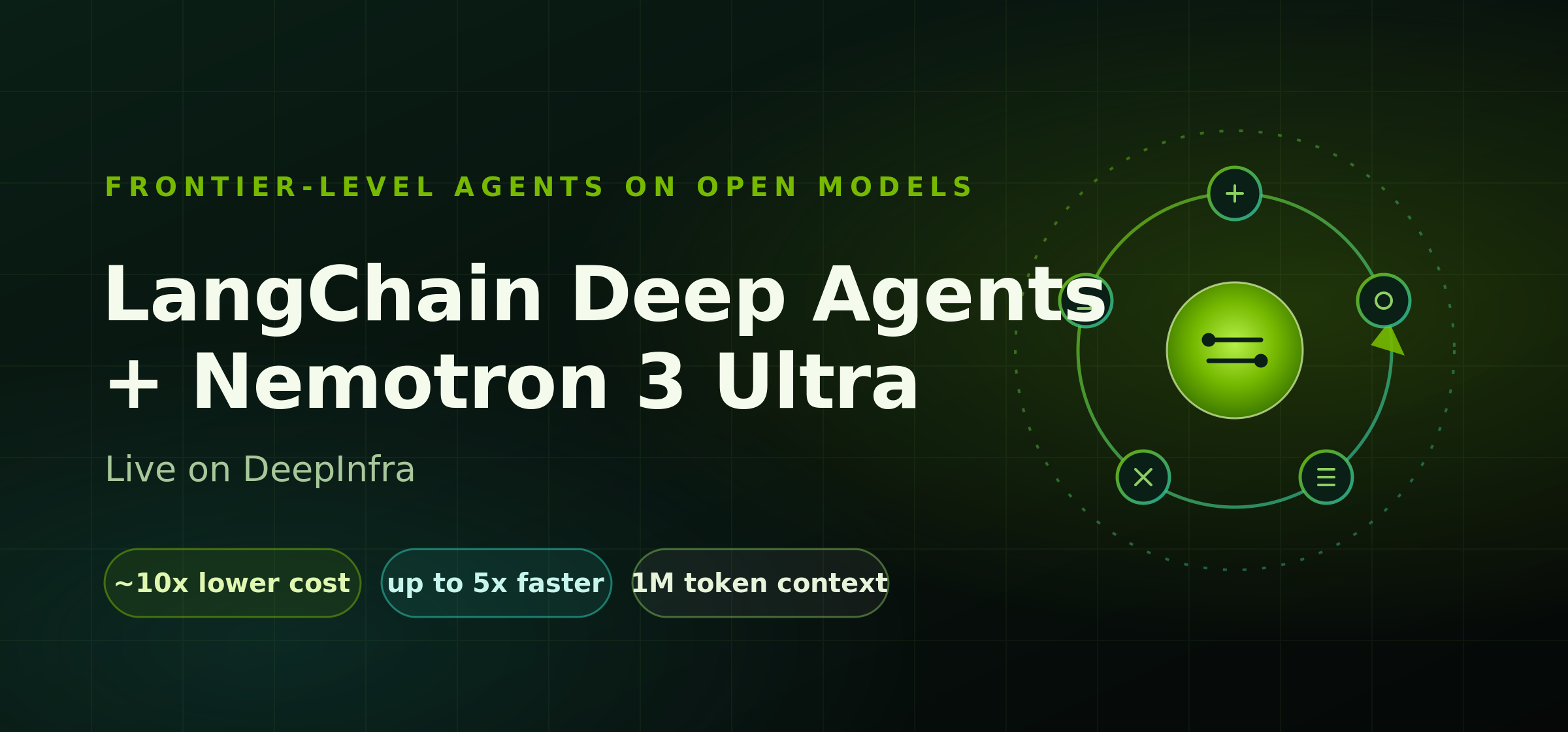 Frontier-Level Agents on Open Models: LangChain Deep Agents + NVIDIA Nemotron 3 Ultra, Live on DeepInfraOpen models have reached frontier-level agent performance. Starting today, you can point LangChain Deep Agents at NVIDIA Nemotron 3 Ultra running on DeepInfra and get top-tier agent accuracy at roughly 10x lower cost than leading closed models.




© 2026 DeepInfra. All rights reserved.